
Here’s the uncomfortable truth about Fiverr: the hard part isn’t doing the work — it’s getting found. Your first gig will sit deep in the search results with zero reviews, competing against sellers with thousands of them. Nobody’s coming.
That’s actually good news. It means getting your first client is a system problem, not a talent problem — and systems can be worked. This playbook covers how Fiverr search really treats new sellers, how to build a gig buyers click, honest pricing math with the fees baked in, and the unglamorous steps that earn that first review. No income promises, no “make $10,000 in your first month” nonsense.
How Fiverr Search Actually Works for New Sellers
Fiverr’s search has one job: show buyers the gigs most likely to result in a completed, satisfying order. For a new seller, that creates a cold-start problem you need to understand first.
What the algorithm weighs. Fiverr doesn’t publish its formula, but the observable factors are consistent: keyword relevance, conversion rate (do viewers order?), reviews, response time, completion rate, and on-time delivery. Almost everything on that list is earned through completed orders — which is exactly what you don’t have yet.
Why new gigs get a brief audition. New gigs typically get a short window of extra visibility so Fiverr can test buyer response. If people click and order, you stay visible; if they bounce, you sink. Launch with a polished, complete gig — a half-finished one wastes its one audition.
The realistic timeline is weeks, not days. Sellers who expect instant results usually quit in week two and conclude “Fiverr doesn’t work.” The ones who land clients are still optimizing and promoting in week six. Treat the first month or two as learning, not failure.
If you’re still deciding whether Fiverr is even the right platform for you, our Fiverr vs Upwork comparison for beginners walks through which model fits which person — worth reading before you invest weeks here. And if Upwork turns out to be your pick, our guide to getting your first client on Upwork covers the proposal system from profile to first contract.
Step 0: Set Up a Seller Profile Buyers Trust
Before you build a gig, set up your profile — it’s the page buyers land on when they click your name, and a thin one kills conversions.
Use a real photo. Not a logo, not a stock image. Buyers hire people, and a clear, friendly headshot builds trust. A well-lit phone photo is fine.
Write the description for buyers, not yourself. Lead with the service and who it’s for: “I help YouTubers turn raw footage into polished videos with captions and clean audio” beats “I’m a passionate creative professional.” Specific beats adjectives.
List real skills and languages — and complete verification. Accurate skills feed the system that matches buyer briefs to sellers. Complete any phone/ID verification and required skill tests for your category — skipping them can delay your launch.
Step 1: Pick ONE Sellable Service
The biggest beginner mistake is offering five vague services. “I do graphic design, video editing, writing, data entry, and voiceovers” reads as “I do nothing well.” Buyers search for specific problems; the gig that wins is specific.
The specificity test. Narrow your skill until it fits one sentence a buyer would type: “video editing” becomes “I will edit your talking-head YouTube video with captions.” Each narrowing cuts your competition and matches real searches.
Sellable beats impressive. Your service needs to be something buyers already search for — logo design, video editing, voiceovers, resume writing, data cleanup, translation, simple WordPress fixes. Boring, proven, searched-for. Exotic offerings are a harder first gig because you’re doing market education on top of selling.
One service, several angles. As a new seller you can create up to 4 gigs, so build 2–4 around your one core service from different angles — different buyer types, deliverables, or price points. A video editor might run “talking-head YouTube editing,” “short-form/Reels editing,” and “wedding highlight editing” as separate gigs. Same skill, three search audiences.
Still unsure what to sell? Our realistic freelancing starter plan walks through picking a service based on skills you already have — a good companion read before you build anything.
Step 2: Build the Gig — Anatomy of One That Converts
Your gig page is a product listing, and every element either earns the click or loses it. Here’s what each part needs to do.
Title: match the search, not your ego
Your gig title is the most important ranking element you control — it should contain the exact words buyers type. “I will design a professional minimalist logo for your business” beats “Premium bespoke brand identity solutions” because buyers search “logo design,” not “bespoke brand identity.”
Formula: I will [specific deliverable] for [specific buyer]. Plain, searchable, no cleverness. Clever titles don’t rank.
Pricing tiers: Basic, Standard, Premium
Fiverr lets you offer three packages per gig — use all three, with clear escalating value:
- Basic: the smallest useful version. A 30-second voiceover, a single logo concept, one page of copy. Your entry point and review-earner.
- Standard: your core offer and main earner — this is where most buyers should land.
- Premium: the full service. Rush delivery, source files, extra revisions, a consultation call.
Add gig extras (faster delivery, additional revisions) so buyers can customize upward — upsells are where real margins live.
Description: answer the buyer’s silent questions
A buyer reading your description asks four things: What exactly do I get? How is this different from the other gigs? Do I trust this person? What do you need from me? Answer all four, in that order.
Be concrete: deliverables, turnaround, revision policy, file formats. Say who it’s for and who it isn’t — disqualifying bad-fit buyers prevents bad reviews. Write for humans first; keyword-stuffed descriptions read as spam.
FAQ and requirements: kill friction before it kills the sale
The FAQ preempts the questions every buyer asks (turnaround, revisions, source files, commercial rights). Every answer here is one less message before an order — faster decisions mean more orders. Keep requirements specific and minimal: twelve pre-order questions sends buyers elsewhere.
Samples and images: proof beats promises
With zero reviews, your samples are your credibility. Make the first gig image count — it’s your search thumbnail, and clean, readable thumbnails with clear text win.
No client work yet? Create samples and label them honestly: fictional-company logos, re-edited public-domain footage, spec writing pieces. Buyers need to see what they’ll get. A short gig video — even a screen recording — is consistently associated with better conversion.
Gig SEO: tags, category, and metadata
Use all your search tags with terms buyers type: “logo design,” “youtube thumbnail” — not “brand alchemy.” Pick the most specific subcategory, and complete all gig metadata (style, formats, language): these are search filters, and filtered-out gigs silently vanish. One caution: don’t rewrite titles and tags every few days — constant edits reset the signals Fiverr is collecting. One thoughtful pass, then leave it two to three weeks.
Step 3: Pricing Math — The 20% Reality
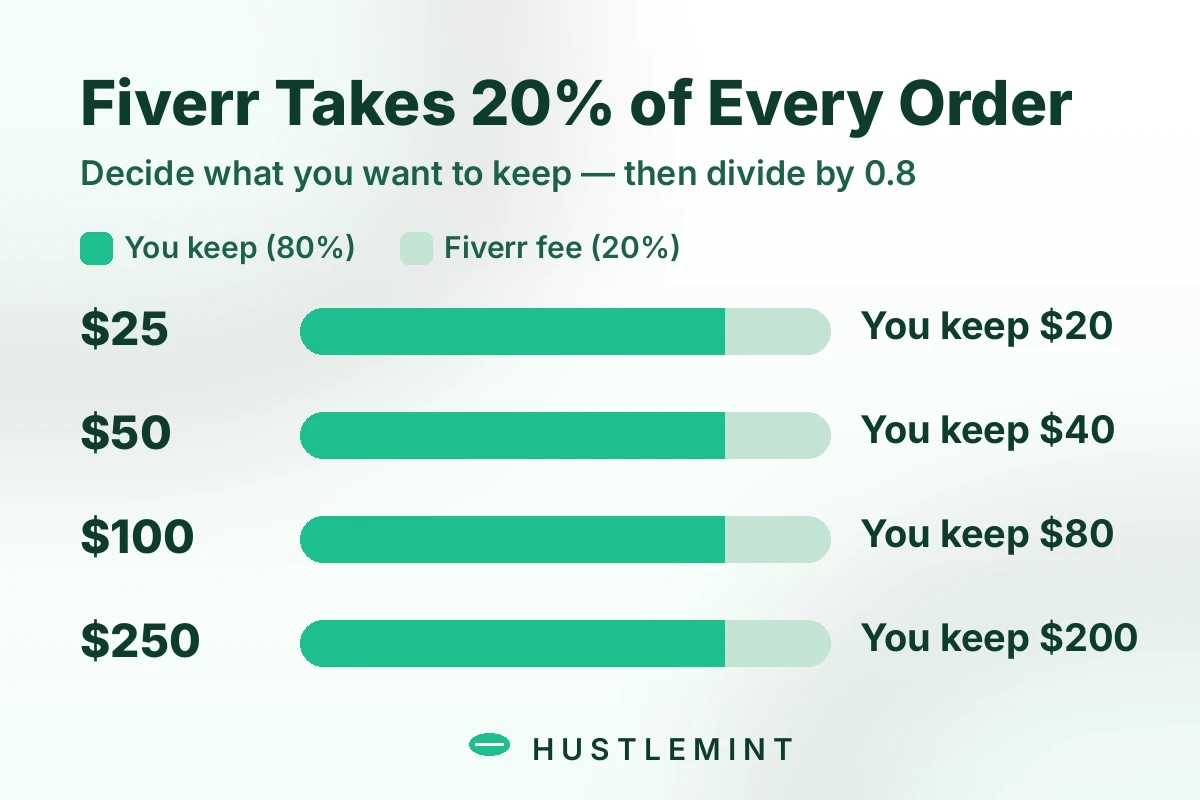
Fiverr takes a flat 20% commission on every order, including tips, at every seller level. No volume discounts, no loyalty tiers. Your entire pricing strategy orbits this number — so work backwards: decide what you want to keep, then divide by 0.8. Want $40? Price at $50. Want $100? Price at $125. Do it before you publish, not after your first payout disappoints you.
| Gig price | Fiverr keeps (20%) | You receive |
|---|---|---|
| $25 | $5 | $20 |
| $50 | $10 | $40 |
| $100 | $20 | $80 |
| $250 | $50 | $200 |
 Why tiny gigs are a trap. The $5 gig is mostly nostalgia. On a $5 order you keep $4 — and the buyer pays noticeably more than $5 after Fiverr’s buyer-side fees (around 5.5% plus a small flat fee on smaller orders; the exact flat amount changes, so check Fiverr’s current help pages). When a big slice of a small transaction goes to the platform, pricing at the bottom means working for pocket change. Price your smallest package at a level where the work is worth your time after the 20%.
The beginner pricing strategy. Start modestly — below your long-term target, not rock-bottom — to earn first reviews. Your first 5–10 orders buy proof, not profit. Then raise prices as reviews accumulate; buyers pay more happily when the history justifies it. Plan increases in advance: “first 10 orders at $X, then $Y.”
Run the monthly math, not just the per-gig math. A $50 gig nets you $40 — but if it takes three hours and you land four a month, that’s $160 for 12 hours of work. Before committing to a price, multiply: (price × 0.8) × realistic monthly orders. If that number doesn’t justify the hours, raise the price or pick a service with better economics. This one calculation prevents the classic beginner trap: being “busy” on Fiverr while earning less than minimum wage.
For a deeper look at pricing services so the math works in your favor long-term, see our guide to pricing service side hustles and winning repeat clients. Once your packages are set, use our freelance pricing guide to gross up your rates for the 20% fee and taxes before you quote.
Step 4: Getting the First Order
You can’t just publish and wait — but you can’t force it either. What works is platform mechanics plus modest outside effort.
Respond to matched briefs. The old “Buyer Requests” board was discontinued and replaced by Fiverr’s brief/matching system: buyers describe their project, Fiverr matches it to relevant sellers, and matched sellers can send an offer. Keep your gigs complete and your profile active to stay eligible, and answer every matched brief quickly and specifically. A fast, tailored response beats a perfect gig sitting idle.
Promote your gigs yourself. Fiverr won’t do your marketing for you at first. Share your gig where your buyers are: relevant subreddits (read the rules first — most ban self-promotion, so lead with genuine help), niche Facebook groups, LinkedIn for business clients, X/Twitter in your industry’s conversations. Same rule everywhere: be useful first, mention your service second.
Response time is a ranking factor. Fiverr tracks how fast you reply, and it feeds your visibility. Turn on notifications and answer promptly — in the first weeks, every inquiry might be your first order.
Patience is the actual strategy. Most new sellers don’t fail because their gig is bad — they fail because they quit in week three. Your first order might come from a matched brief, a search click in week five, or a post you shared. Keep gigs polished, respond fast, and expect a slow build, not a launch.
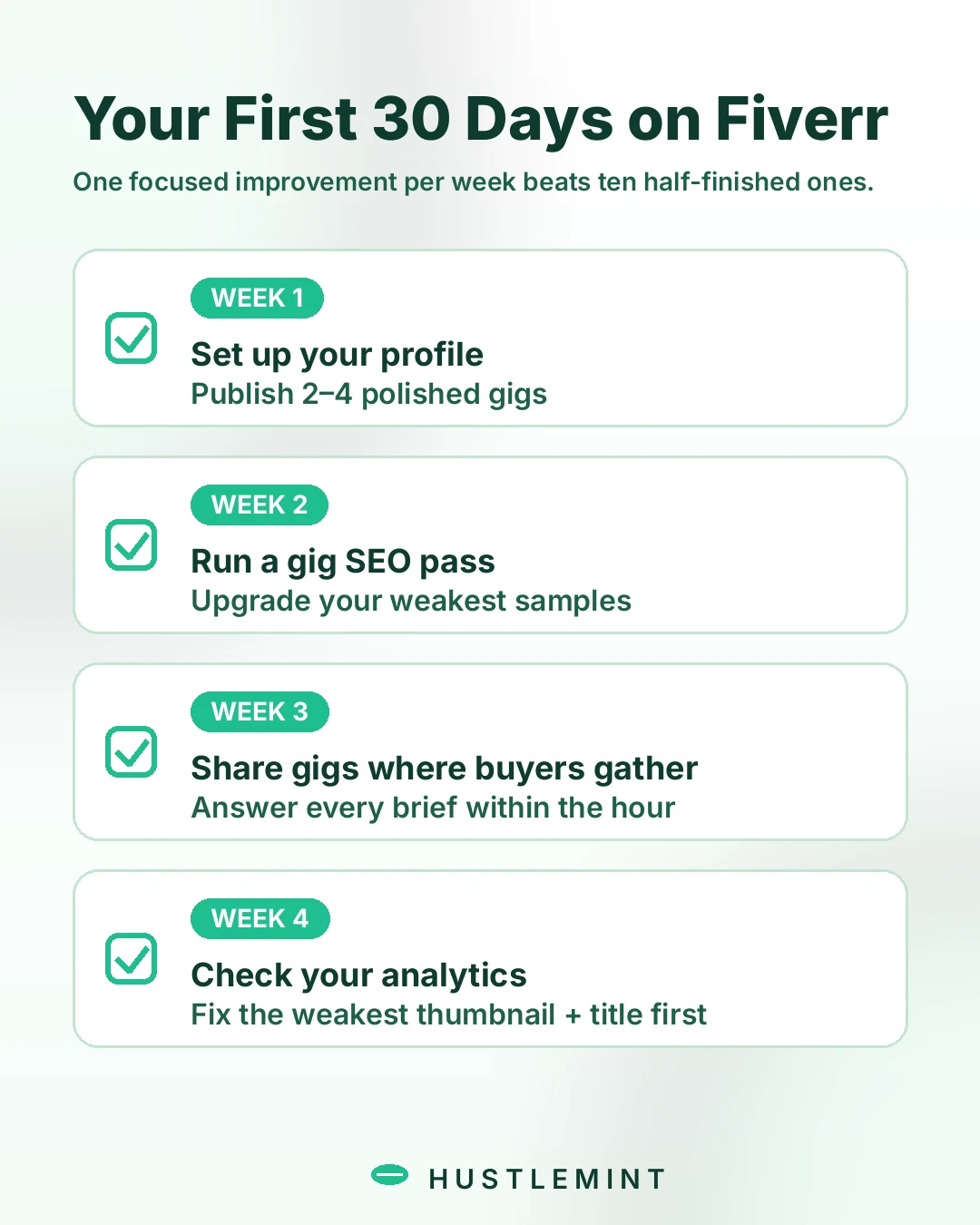
Your first-30-days checklist. Week one: profile plus 2–4 polished gigs. Week two: gig SEO pass and upgrade weakest samples. Week three: share gigs where buyers gather; answer every matched brief within the hour. Week four: check analytics, fix the weakest gig’s thumbnail and title first. One focused improvement per week beats ten half-finished tactics.
 Diagnose your funnel when orders stall. Lots of impressions but few clicks: your thumbnail and title aren’t winning — fix the first image and the title’s first five words. Clicks but no orders: the gig page isn’t converting — tighten the description, upgrade samples, check pricing. Few impressions: a relevance problem — revisit tags, category, and keywords. Each symptom has a different fix.
Step 5: Deliver Like Your Career Depends on It (It Does)
Your first few orders shape your gig’s future more than anything else. Early reviews are weighted heavily — a gig with three 5-star reviews converts dramatically better than one with zero — and they feed the ranking factors too.
Over-deliver on the first orders. Deliver early. Confirm you understood the brief, send a quick update midway, and deliver with a short summary of what you did. This isn’t working for free — it’s making the 5-star review a foregone conclusion.
Handle revisions gracefully. Build a reasonable revision count into your packages and treat requests as collaboration, not conflict. The best-rated sellers aren’t the ones who never get revision requests — they’re the ones who handle them without drama.
Ask for the review — politely, once. After a successful delivery: “If you’re happy with the work, a review would mean a lot as I’m building my profile.” Don’t beg, don’t offer discounts for reviews (against the rules — bannable), don’t follow up repeatedly. One ask, then let it go.
Know when to push through and when to walk away. If a buyer keeps expanding scope beyond what they paid for, point politely to your packages and offer the upgrade as a gig extra — don’t silently absorb free work. If a buyer is abusive or asks you to break Fiverr’s rules, use the resolution center. And if an order is genuinely going wrong, communicate early: a proactive message about a delay beats a last-minute cancellation, which damages the completion metrics your ranking depends on.
Know the payment timeline. When an order completes — the buyer marks it complete, or it auto-completes a few days after delivery if they don’t respond — earnings enter a clearing period: 14 days for new sellers before withdrawal (around 7 days once you reach Top Rated or Pro). After clearing, withdraw via PayPal, bank transfer, or a Fiverr revenue card, depending on your country. Minimums are small but fees vary by method, so check current terms. Practical takeaway: your first payout arrives roughly two to three weeks after your first completed order.
Step 6: Level Up
Fiverr’s seller levels — New Seller, Level 1, Level 2, Top Rated — are earned through performance: completed orders, positive ratings, on-time delivery, responsiveness. Not purchased; no shortcuts.
Each level unlocks real perks: more gig slots beyond the 4 you start with, faster payment clearing, promotional tools. Levels are also buyer trust signals — a Level 2 badge does quiet selling for you.
What actually moves you up is boring consistency: deliver on time, keep ratings high, respond quickly, avoid cancellations. Cancellations hurt your completion rate, which hurts both ranking and level progress — only accept orders you can deliver, and communicate early if something goes wrong. Fiverr evaluates metrics over rolling 60-day windows, so one bad week won’t permanently sink you, but a pattern of late deliveries stalls progress for months. Top Rated adds a manual review by Fiverr’s team — one more reason to keep your profile professional from day one.
Mistakes That Kill New Fiverr Accounts
- Buying fake reviews or gaming the system. Fiverr detects it; the penalty is restriction or a permanent ban. Earned reviews are slower and actually worth something.
- Taking payment or communication off-platform. A “buyer” who wants to pay by wire, crypto, or check — or move to Telegram/WhatsApp — is scamming you or risking your account. Fiverr’s protection only covers on-platform orders. No exceptions. Learn to spot the common job scam patterns before you need them.
- Accepting orders you can’t deliver. Missed deadlines and cancellations damage the metrics behind your ranking and level. Decline or clarify upfront rather than fail publicly.
- Pricing without the fee. A $100 project is an $80 project. Subtract before you accept, not after.
- Copying top sellers’ gigs. Study them to learn titling, pricing, and packaging — then write your own. Copied gigs get reported, and buyers can feel the inauthenticity.
- Quitting at week three. The first client is the hardest part of Fiverr. Most people who “fail” didn’t fail at the work — they failed at patience, right before it would have started working.
- Treating Fiverr like a lottery ticket. One vague gig plus waiting is a wish, not a strategy. Treat the first month like a product launch: specific service, polished listing, active promotion, fast responses, weekly improvements from analytics.
Frequently Asked Questions
How long does it take to get your first client on Fiverr?
There’s no honest universal timeline. Realistic expectations: weeks, not days. New gigs need time to earn visibility, and first orders often come from matched briefs or outside promotion rather than search. Plan for a slow first month or two.
Do I need experience or a portfolio to start on Fiverr?
Fiverr doesn’t require credentials, but buyers need a reason to trust you. Sample projects, practice work, and before-and-after examples all count as proof. A gig with honest sample work — even if none was for a paying client — outsells one with zero samples.
How much does it cost to start selling on Fiverr?
Joining and creating gigs is free. Fiverr earns the 20% commission on your completed orders — you pay nothing upfront. Anyone charging a “registration fee” to sell on Fiverr is running a scam, not a real requirement.
Can I really make a living on Fiverr?
Some sellers do, but treat that as a long-term possibility, not a starting expectation. Your first months are paid education: learning the platform, earning reviews, finding your pricing. Sellers who eventually earn full-time income started with modest expectations and raised prices as their reputation grew.
Is Fiverr safe for new sellers?
Fiverr itself is legitimate, with payment protection for on-platform orders. The risks come from around the platform: fake buyers requesting off-platform payment, phishing messages, “clients” who overpay and ask for refunds. Keep all communication and payment inside Fiverr, and be skeptical of anything urgent or too good to be true.
Should I offer the cheapest price to get started?
Cheap isn’t a strategy — it’s a trap. Rock-bottom pricing attracts the hardest buyers, leaves pennies after the 20% commission, and signals low quality. Price modestly below your long-term target to earn first reviews, but never below what the work is worth after fees.
Can I sell on Fiverr if I’m outside the US?
Yes — Fiverr is global. The practical differences are payment and language: check that your country supports your preferred withdrawal method, and be realistic about competing in English-language categories if English isn’t your strength. Many successful sellers work in their native language’s market or in visual categories where language matters less.
Do I owe taxes on Fiverr income?
In the US, freelance income is taxable self-employment income, and Fiverr withholds nothing. Set aside a portion of every payout from day one — the exact percentage depends on your situation, so this isn’t tax advice, just a warning not to learn it in April. Outside the US, check local rules; the platform won’t handle this for you.
Sources
- Fiverr Help Center — seller earnings and the 20% commission structure (sellers keep 80% of each order, including tips): help.fiverr.com
- Fiverr Help Center — buyer service fee (standard 5.5% of purchase price plus a small flat fee on smaller orders; exact flat amount subject to change): help.fiverr.com
- Fiverr Help Center — payment clearing periods (14 days for new sellers; ~7 days for Top Rated and Pro sellers) and withdrawal methods (PayPal, bank transfer, Fiverr Revenue Card): help.fiverr.com
- Fiverr Help Center — gig limits by seller level (new sellers can create up to 4 gigs): help.fiverr.com
- Fiverr Help Center — seller levels overview (New Seller, Level 1, Level 2, Top Rated; earned through performance): help.fiverr.com
- FreelanceNation — “Fiverr Fees: 20% Seller, 5.5% Buyer Fee” (2026 fee breakdown with worked buyer-total examples): freelancenation.com/blog/fiverr-fees-explained
- FiverrTutorials — “How to Post a Project on Fiverr: The Buyer Briefs Guide (2026)” (Buyer Requests discontinued, replaced by the Briefs matching system in 2023): fiverrtutorials.com/post-buyers-request-fiverr
- Medium / Monetize Bio — “How U.S. Fiverr Freelancers Can Withdraw, Manage, and Maximise Earnings” (clearing periods by seller level, withdrawal methods, 20% commission math): medium.com
Bottom line: getting your first Fiverr client is a visibility and trust problem, not a talent contest. Pick one specific service, build a gig that matches what buyers search, price with the 20% already subtracted, respond fast, and give it weeks. The sellers who win on Fiverr aren’t the most talented — they’re the ones still there in week six.