

Setting your first freelance rate feels like guessing — too high and nobody hires you, too low and you work for pennies. This guide is for American beginners who want a real method: how to calculate a rate you can live on, what Fiverr and Upwork actually take from it, and what that rate pays after taxes. The key takeaway: your posted rate is not your pay — once platform fees, business expenses, self-employment tax, and income tax are accounted for, a $50/hour rate works out to roughly $32/hour in the illustration below (which uses stated assumptions and excludes state/local taxes and personal circumstances).
Quick answer: To price freelance work as a beginner, (1) calculate your floor rate — monthly costs divided by realistic billable hours; (2) choose hourly pricing for undefined scopes and project pricing for well-defined deliverables; (3) gross up your rate for platform fees (Fiverr takes a flat 20%; Upwork takes 0–15% per contract); (4) budget for self-employment tax (~15.3% on 92.35% of net earnings) plus income tax — the full five-layer walkthrough is below.
The pricing formula every beginner should start with
Forget copying someone else’s rate. Your rate has to cover your costs, so start with the floor-rate method — the lowest hourly number at which you don’t lose money:
Floor rate = monthly costs ÷ realistic billable hours per month
Two parts need honesty:
Monthly costs means everything: rent or mortgage share, food, insurance, phone, software subscriptions, plus a buffer for savings. Say that totals $1,750.
Realistic billable hours is not 160 (40 hours × 4 weeks). Beginners spend roughly half their time on non-billable work — pitching, admin, learning, revising. A realistic starting assumption is about 80 billable hours a month. (This is an illustrative assumption, not a rule — adjust it to your own schedule.)
The math:
- $1,750 ÷ 80 hours = $21.88/hour — call it $22/hour
- Below $22/hour, you are subsidizing the client. This is your floor, not your rate.
Why the floor is a survival number, not a rate. Covering monthly expenses keeps the lights on — it doesn’t make the business sustainable. The floor above ignores platform fees, taxes, retirement savings, and any profit buffer. A practical gross-up shows the gap: to actually keep $22/hour after a 10% platform fee and ~14.1% effective self-employment tax (15.3% × 92.35%), you’d need to charge $22 ÷ 0.90 ÷ 0.859 ≈ $28.50/hour — and that’s before income tax or a single dollar of savings. A sustainable starting rate sits above the grossed-up floor, not at it. Treat the floor as the number you never go below, and the gross-up as the minimum worth quoting.
Your actual rate sits above the floor. How far above depends on the pricing model you choose — which is the next decision.
Hourly vs project pricing (and the value-based option, honestly explained)
There are three ways to charge. Beginners should understand all three but will mostly use the first two.
Hourly pricing
You charge per hour worked, tracked with a timer or the platform’s tracker. Choose hourly when the scope is unclear — ongoing work, revisions-heavy projects, or clients who can’t describe exactly what they want. It protects you when a “quick task” turns into six rounds of feedback.
The downside: your income is capped by your hours, and efficient workers get penalized — finish in two hours what you estimated at four, and you earn less for being good.
Fixed-price (project) pricing
You quote one price for a defined deliverable: “$150 for a 1,000-word blog post,” “$400 for a logo with two revision rounds.” Choose project pricing when the deliverable is well-defined — you know the scope, the timeline, and roughly how long it takes you. As you get faster, your effective hourly rate rises without renegotiating.
The risk is scope creep: the client keeps adding “just one more thing.” Protect yourself with a written scope and a revision limit in every quote (more on this below).
Value-based pricing — the honest beginner’s guide
Value-based pricing means charging based on the result for the client (“this landing page could generate $20,000 in sales, so I charge $2,000”) rather than your time. You’ll see it praised as the advanced move — and it can be, but it requires something beginners don’t have yet: proof. Without a track record of results, value-based quotes sound like bluffing, and most beginners can’t defend them in a negotiation.
The realistic path: start with hourly or project pricing, collect proof (testimonials, metrics, before-and-after examples), and revisit value-based pricing once clients come to you asking for outcomes. If a guide tells a week-one freelancer to “just charge based on value,” it’s skipping the part where credibility comes from.
Your rate is not your pay: gross revenue vs fees vs expenses vs taxes
This is the section most pricing guides skip, and it’s the one that costs beginners the most money. Five layers sit between your posted rate and your pocket:
- Gross revenue — what the client pays (your rate × hours, or the project price).
- Platform fees — what Fiverr or Upwork deducts before you see a cent.
- Business expenses — software, Connects, equipment, home-office costs.
- Self-employment tax — in the US, ~15.3% on 92.35% of your net earnings.
- Income tax — federal (and usually state) tax on what’s left after deductions.
Miss any layer and your “great rate” quietly becomes a bad one. The next section works the platform-fee layer with real numbers, because that’s where beginners lose the most.
What the platforms actually take (verified October 2026)
Fiverr: flat 20% on everything
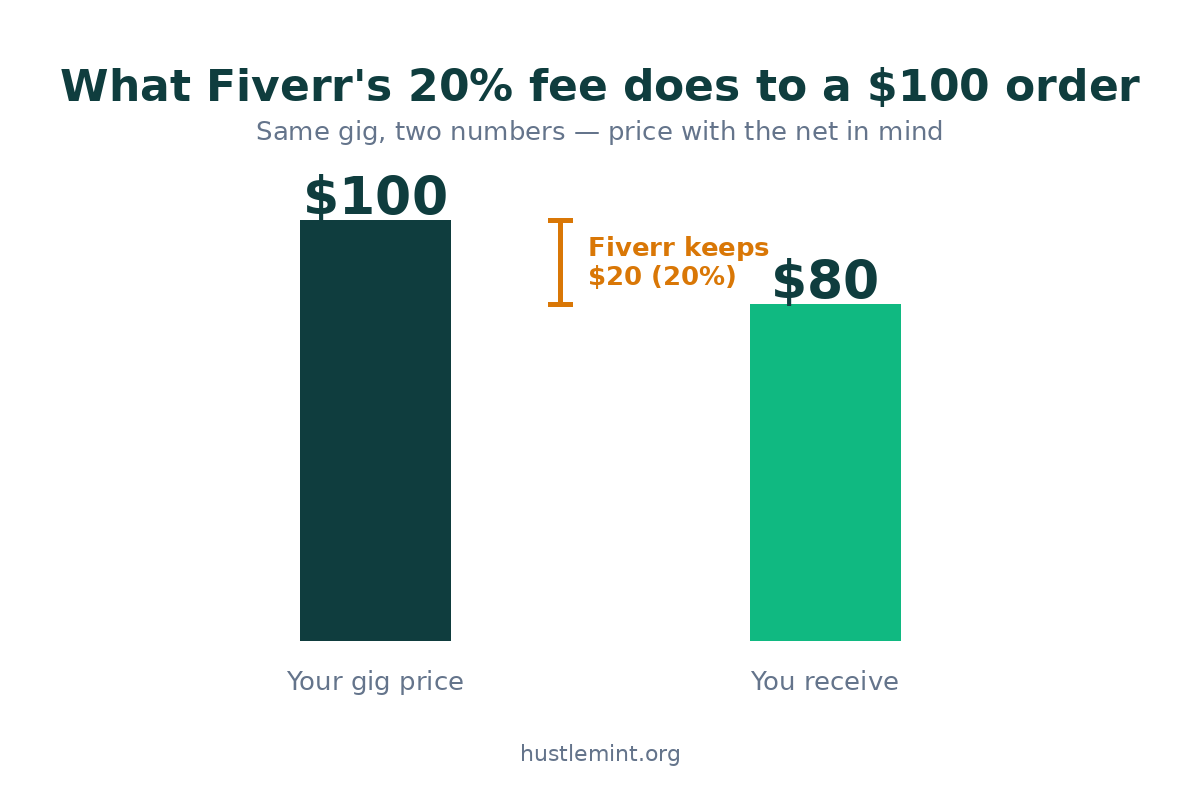
Fiverr takes a flat 20% commission on every order, including tips — no tiers, no volume discounts, no exceptions. Fiverr’s Help Center states sellers earn 80% of the purchase amount, including Gig Extras and tips (Your earnings page, verified October 2026). The math is simple and brutal:
| Order value | Fiverr keeps (20%) | You receive |
|---|---|---|
| $25 | $5.00 | $20.00 |
| $50 | $10.00 | $40.00 |
| $100 | $20.00 | $80.00 |
Calculation shown: $100 × 0.20 = $20 fee; $100 − $20 = $80 net. A $50 gig that “pays $50” actually pays $40 — price every gig with that math in mind. (For the full comparison of the two platforms, see our Fiverr vs Upwork comparison for beginners.)
Upwork: 0–15% per contract, plus proposal costs
Upwork’s freelancer service fee is variable: 0% to 15% per contract, set when you submit the proposal and fixed for that contract’s life (Upwork Help Center — Freelancer Service Fee; Fee and ACH Authorization Agreement §2.1, effective July 20, 2026). A warning worth heeding: many third-party guides still quote Upwork’s old 20%/10%/5% sliding scale — that structure is stale (pre-2025) and should not be used.
| $500 contract | Fee | You receive |
|---|---|---|
| At 5% | $25.00 | $475.00 |
| At 10% | $50.00 | $450.00 |
| At 15% | $75.00 | $425.00 |
Calculation shown: $500 × 0.10 = $50 fee; $500 − $50 = $450 net. Because the fee varies per contract, the same $500 of work can net anywhere from $425 to $475 — always check the fee shown before you submit a proposal.
Upwork has costs beyond the service fee that beginners miss:
- Connects cost $0.15 each (Upwork’s official Connects guide, verified October 2026) — you spend Connects to submit proposals, so bidding is not free. Ten proposals at 6 Connects each = 60 × $0.15 = $9.00 spent before earning the first dollar. Once your rates are set, our beginner’s guide to getting your first client on Upwork walks through the proposal system step by step.
- Withdrawals are free for US freelancers via ACH / Direct to U.S. Bank (Upwork’s support docs; a $2.99 fee added September 2026 applies to international tax addresses only).
The full walkthrough: what $50/hour actually pays
Put all five layers together for a US beginner on Upwork, using a 10% contract fee as the illustration:
- Gross: $50/hour × 1 hour = $50.00
- Platform fee: $50 × 0.10 = $5.00 → $45.00
- Business expenses: an illustrative $2.00/hour (software, Connects, equipment spread across billable hours — yours will differ) → $43.00 net earnings
- Self-employment tax: the IRS applies 15.3% to 92.35% of net earnings (Schedule SE): $43.00 × 0.9235 = $39.71; $39.71 × 0.153 = $6.08 → $36.92
- Income tax (simplified illustration — not a personal tax calculation): applying a flat 12% marginal rate to net earnings minus the deductible half of SE tax: ($43.00 − $3.04) × 0.12 = $4.80 → $32.13, roughly $32/hour. Real income tax depends on your total income, filing status, deductions, and state — this placeholder shows the layer exists; it is not your actual bill.
That is the honest number to plan around: a $50/hour posted rate works out to roughly $32/hour of take-home pay in this illustration — after the platform fee, business expenses, self-employment tax, and a simplified income-tax assumption (state and local taxes and personal circumstances not included). (Every figure is an illustrative calculation based on stated assumptions — a 10% contract fee, $2/hour expenses, a 12% marginal bracket — not an earnings promise and not your personal tax calculation. Your contract fee, expenses, bracket, deductions, state/local taxes, and circumstances will differ. See the source record for the IRS references behind the SE-tax math.)
Setting your first rate: a worked example
Combine the floor-rate method with market context:
- Start at your floor. From the earlier example: $22/hour. Never quote below this.
- Check market anchors — carefully. The Bureau of Labor Statistics reports May 2025 median pay of $36.98/hour for writers and authors, $30.27/hour for graphic designers, and $43.46/hour for technical writers (BLS Occupational Outlook Handbook). These are employee medians, not freelancer rates — they tell you what the market pays for the skill in a salaried job, not what a beginner freelancer will earn. Use them as context, never as a promise.
- Apply the 1.5–2× heuristic. A widely cited rule of thumb says freelancers should charge roughly 1.5 to 2 times the equivalent salaried hourly rate, to cover taxes, benefits, downtime, and unpaid work. (This is a heuristic, not a researched fact — treat it as a sanity check.) At a $30/hour salaried equivalent, that suggests $45–$60/hour as a starting range to test.
- Adjust for the platform. On Fiverr, a $60 posted rate nets $48 after the 20% fee. On Upwork at a 10% contract fee, it nets $54 before Connects costs. Work backward from what you need to keep.
- Test and adjust. Your first rate is a hypothesis, not a tattoo. Quote it for two to four weeks; if everyone says yes immediately, take it as a strong signal it’s too low.
What beginners in various fields report charging (spunk.work’s 2026 rate table — reported figures, not verified by us): web development $50–$75, design $35–$60, copywriting $40–70, video $40–$65, SEO $50–$80, social media $30–$50 (beginner tier). Treat these as what others say they charge, not as verified market data.
For platform-specific tactics once your rate is set, our playbook for getting your first Fiverr client covers pricing your gig packages around the 20% fee.
When and how to raise your rates
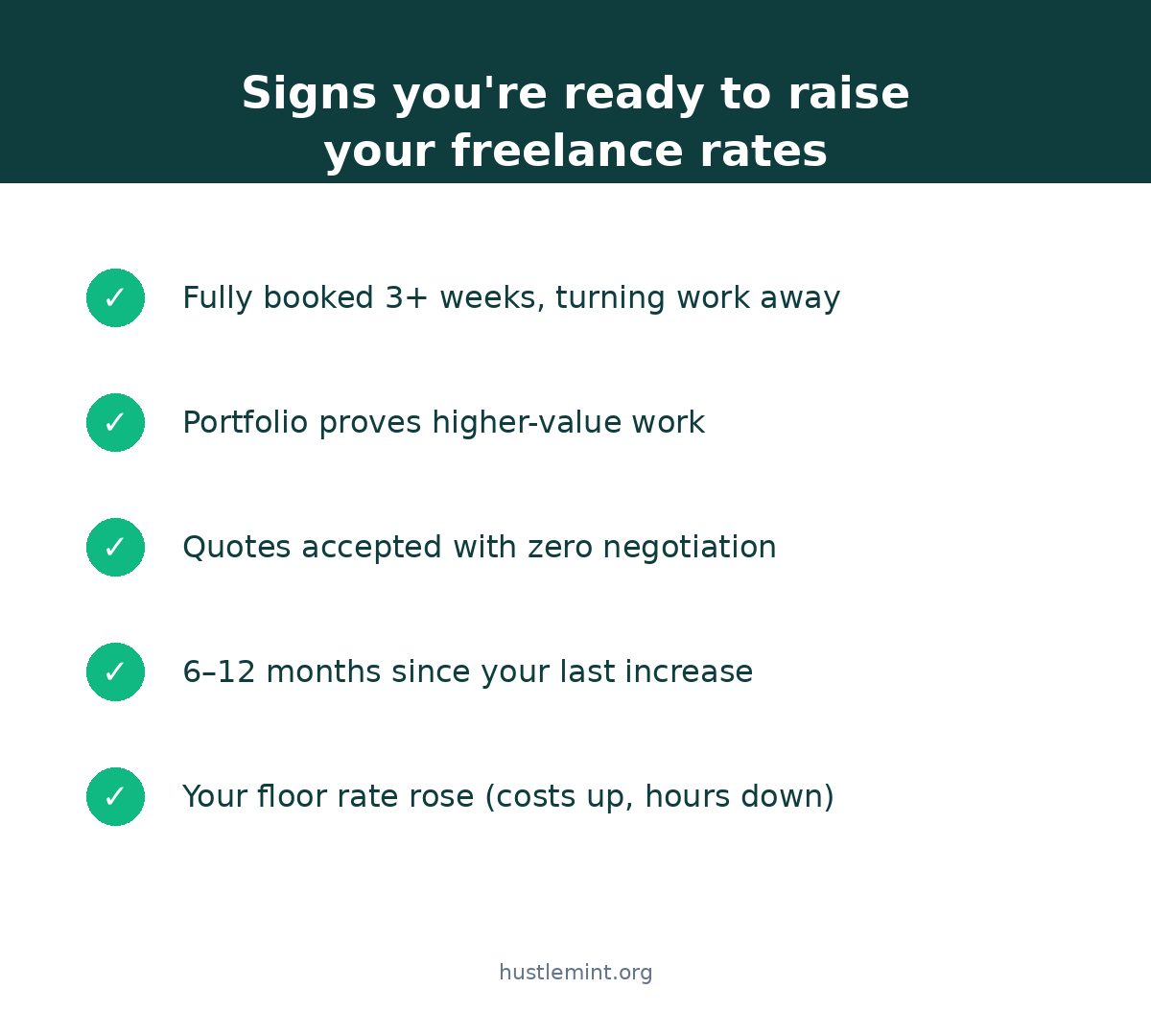
Beginners undercharge — that’s normal, and it’s fixable. Raise your rates when the evidence says so, not when you feel brave enough. Checklist — raise when two or more are true:
- You’re fully booked for 3+ weeks and turning work away
- New portfolio pieces prove higher-value work than your current rate reflects
- Clients accept your quotes with zero negotiation, every time
- It’s been 6–12 months since your last increase
- Your floor rate rose (costs went up, billable hours went down)
How to raise without losing clients: apply the new rate to new clients first. Existing good clients get 30 days’ notice and one last project at the old rate. You don’t need to justify the number — “my rates increased as of [date]” is a complete sentence.
Underpricing traps beginners fall into
Competing on price alone tends to attract the toughest clients. Clients shopping purely on price are often the most likely to demand endless revisions, pay late, and leave harsh reviews over minor issues. It’s a race to the bottom you can’t win — someone will always charge less.
Scope creep eats fixed-price profits. “Just one more revision” repeated five times turns a profitable project into hourly minimum wage. Every quote needs a written scope (exactly what’s included) and a revision limit (e.g., two rounds; additional rounds billed at your hourly rate).
“Exposure” doesn’t pay rent. Work for testimonials or portfolio pieces is a legitimate strategy — deliberately, occasionally, for the right client. Work for exposure as a default is just underpricing with better marketing. As a rule of thumb, cap it: no more than one discounted project per quarter, and never for clients who can clearly afford your rate.
Forgetting the fee math. One of the most common traps: quoting $500 for a project, then discovering the platform and tax layers. Always run the five-layer math from this guide before you quote, not after you get paid. For a concrete look at what beginners actually charge in one popular lane, see how much virtual assistants make.
US tax basics for freelancers (read this before you spend it)
In the US, freelance income makes you a 1099 contractor, not an employee — which changes the tax picture:
- Self-employment tax is ~15.3% (12.4% Social Security + 2.9% Medicare) on top of regular income tax. Nobody withholds it for you; you owe it on your net freelance earnings.
- Quarterly estimated payments: the IRS expects you to pay as you earn — typically in April, June, September, and January. Skip them and you can owe underpayment penalties.
- Track everything from day one: income, platform fees, software, home-office costs, mileage. A simple spreadsheet beats a shoebox of receipts at tax time. (For 2026, clients generally issue a 1099-NEC if they pay you $2,000+ in a year — up from $600 before 2026. Income below that threshold is still taxable and must be reported.)
- This isn’t tax advice — consider a tax professional, especially in your first year. Penalties for underpaying estimated tax are entirely avoidable with proper planning.
Frequently asked questions
How much should I charge as a freelancer with no experience?
Start with the floor-rate method in this guide: monthly costs divided by realistic billable hours (around 80/month for most beginners). That number — often in the $20–$30/hour range for a lean budget — is your absolute minimum, not your quote. Gross it up for platform fees and taxes first: the walkthrough shows a $22 floor becoming roughly $28.50/hour before income tax — that grossed-up figure is the minimum worth quoting. Then check the market context for your skill and adjust upward; beginners who can show any proof of skill (samples, a small portfolio, a certification) can typically start above that. Quote your starting rate for two to four weeks and adjust based on response.
Should I charge hourly or per project as a beginner?
Charge hourly when the scope is unclear or the client can’t define the deliverable — it protects you from endless revisions. Charge per project when the deliverable is well-defined and you know roughly how long it takes — as you get faster, your effective hourly rate rises. Most beginners use both: hourly for exploratory work, project pricing for standardized deliverables.
How do I know when to raise my freelance rates?
When two or more items on the trigger checklist above are true: consistently fully booked, zero pushback on quotes, 6–12 months since the last increase, or rising costs. Apply new rates to new clients first; give existing clients 30 days’ notice.
Do I really lose that much to fees and taxes?
Run your own numbers with the five-layer math in this guide, but the illustrative walkthrough is representative: a $50/hour Upwork rate at a 10% contract fee nets $45 pre-tax, about $43 after illustrative business expenses, roughly $37 after self-employment tax, and roughly $32 after illustrative income tax. Platform fees plus taxes are the largest deductions for most beginners, which is why the walkthrough above matters more than any rate formula.
What’s the difference between what I charge and what I keep?
What you charge (gross revenue) minus platform fees minus business expenses minus taxes equals what you keep. On Fiverr, the platform layer alone is a flat 20%; on Upwork it’s 0–15% per contract plus Connects costs. Taxes take roughly another 15.3% for Social Security and Medicare alone. Always quote from the “keep” number backward, not from the “charge” number forward.
Pricing verified against official platform documentation, October 2026. Platform fees change — if a number here looks different on the official page, the official page wins. Next freshness review: April 2027.