
A client’s invoice due date has passed, and you’re staring at a blank email wondering what to write. Too soft, and you get ignored. Too hard, and you risk the relationship — and maybe the payment.
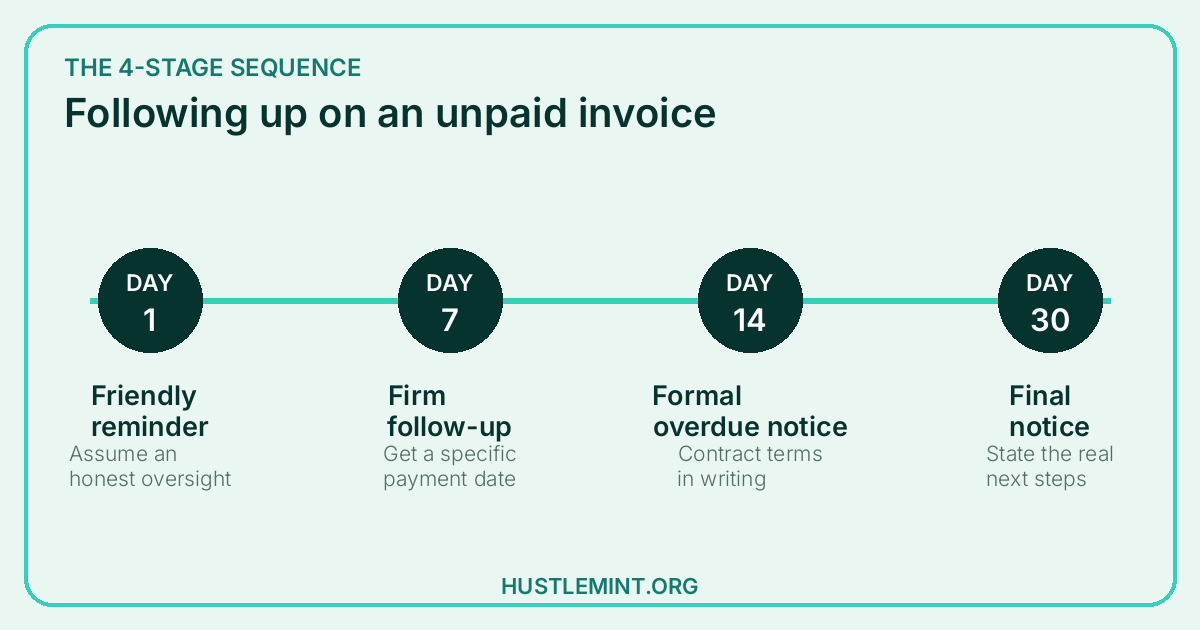
This guide gives you a complete four-stage sequence of copy-paste emails for days 1, 7, 14, and 30 past due. Each stage is firmer than the last, but every one stays factual and professional. It’s written for US freelancers — solo designers, writers, developers, consultants, and anyone else who bills clients directly — and it includes conservative notes on late fees, contracts, and what to do when emails stop working.
The sequence at a glance
| Stage | When to send | Goal | Tone |
|---|---|---|---|
| 1 — Friendly reminder | 1 day past due | Surface the invoice; assume an honest oversight | Warm and brief |
| 2 — Firm follow-up | 7 days past due | Confirm the invoice was received; get a specific payment date | Polite but direct |
| 3 — Formal overdue notice | 14 days past due | Put the amount, the contract terms, and any agreed late fee in writing | Formal and factual |
| 4 — Final notice | 30 days past due | State the next steps you will actually take | Calm and final |
A few habits apply at every stage:
- Send in writing and keep copies. Your email thread is your paper trail if this ever goes further.
- Attach the invoice every time. “I never got it” is the most common innocent cause of late payment — remove it as an excuse.
- Keep a simple record of what you’re owed, when each invoice was due, and when you followed up. Tracking receivables alongside your other business numbers takes minutes and saves real stress later.
- One issue per email. Don’t mix a payment reminder with project feedback, new proposals, or complaints about the working relationship.
Stage 1 (Day 1): The friendly reminder
Subject: Quick check-in: Invoice [INVOICE NUMBER] for [PROJECT OR SERVICE]
Hi [CLIENT FIRST NAME],
I hope you’re doing well. I’m writing with a quick check-in on invoice [INVOICE NUMBER] for [AMOUNT], covering [PROJECT OR SERVICE], which was due on [ORIGINAL DUE DATE]. I haven’t seen the payment come through yet, so I wanted to make sure the invoice actually reached you — inboxes are easy to lose things in.
I’ve attached a copy of the invoice to this email to save you the search. If it’s already in your payment queue, please disregard this note — and thank you.
If anything looks off — a missing form, a wrong billing address, a question about a line item — just reply and tell me what you need from me, and I’ll send it right over.
Thanks very much, [YOUR NAME] [YOUR BUSINESS NAME] [YOUR PHONE NUMBER]
Why this wording: It assumes an honest oversight and quietly eliminates the two most common innocent causes — a lost invoice and missing paperwork — so the client can simply pay without feeling accused.
Don’t: Don’t apologize for asking to be paid, and don’t mention late fees or penalties at this stage. There’s nothing to enforce yet, and leading with consequences over a possible clerical error starts the conversation on the wrong foot.
Stage 2 (Day 7): The firm follow-up
Subject: Follow-up: Invoice [INVOICE NUMBER] — [AMOUNT] due [ORIGINAL DUE DATE]
Hi [CLIENT FIRST NAME],
I’m following up on invoice [INVOICE NUMBER] for [AMOUNT], covering [PROJECT OR SERVICE]. The invoice was due on [ORIGINAL DUE DATE] and is now one week past due. I’ve attached a copy again for convenience.
Could you let me know the status of this payment and the date it will be made? If your team needs anything from me to release it — a W-9, a corrected invoice, or vendor paperwork — send me the details and I’ll turn it around promptly.
If there’s an issue with the work or the amount, I’d rather hear about it now so we can address it directly.
Thank you, [YOUR NAME] [YOUR BUSINESS NAME] [YOUR PHONE NUMBER]
Why this wording: Restating the exact amount, invoice number, and due date removes all ambiguity, and asking for a specific payment date turns a vague “soon” into a commitment you can follow up against.
Don’t: Don’t copy the client’s boss or wider team as leverage at this stage, and don’t threaten consequences. Many one-week delays are just an accounts-payable queue, and you want the person reading this to stay on your side.
Stage 3 (Day 14): The formal overdue notice
Subject: Overdue notice: Invoice [INVOICE NUMBER] — [AMOUNT], 14 days past due
Dear [CLIENT CONTACT NAME],
This is a formal notice that invoice [INVOICE NUMBER], in the amount of [AMOUNT] for [PROJECT OR SERVICE], was due on [ORIGINAL DUE DATE] and remains unpaid as of today, [TODAY’S DATE]. I followed up on [DATE OF STAGE 1 EMAIL] and [DATE OF STAGE 2 EMAIL] and have not yet received payment or a payment date.
Under our agreement dated [CONTRACT DATE], payment for this work was due [PAYMENT TERMS FROM YOUR CONTRACT — for example, “within 15 days of the invoice date”].
[INCLUDE THE NEXT PARAGRAPH ONLY IF YOUR CONTRACT CONTAINS A LATE-FEE CLAUSE: Our agreement also provides that [LATE-FEE TERMS FROM YOUR CONTRACT]. Based on those terms, the current balance is [UPDATED BALANCE]. If your contract has no late-fee clause, delete this paragraph entirely — a fee that was never agreed to cannot be added after the fact.]
Please arrange payment by [DATE SEVEN DAYS OUT], or contact me before then with a firm payment date. If part of the work itself is in dispute, please tell me specifically what is in dispute so we can address it.
[INCLUDE THIS SENTENCE ONLY IF YOUR CONTRACT SUPPORTS IT: If I don’t hear from you, I will pause work on remaining deliverables until the account is current, as provided in our agreement.]
Regards, [YOUR NAME] [YOUR BUSINESS NAME] [YOUR PHONE NUMBER]
Why this wording: Putting the dates, the amount, and the contract terms into one factual message creates a clear written record and signals — without insults or bluffing — that this is now a formal matter, not a casual nudge.
Don’t: Don’t invent a late fee, an interest charge, or a legal penalty that isn’t in your contract, and don’t cite laws that don’t apply to your situation. Invented consequences are easy for a client to check, and they undercut everything else in the email.
Stage 4 (Day 30): The final notice
Subject: Final notice: Invoice [INVOICE NUMBER] — [AMOUNT] now 30 days overdue
Dear [CLIENT CONTACT NAME],
Despite my messages of [STAGE 1 DATE], [STAGE 2 DATE], and [STAGE 3 DATE], invoice [INVOICE NUMBER] for [AMOUNT], due [ORIGINAL DUE DATE] for [PROJECT OR SERVICE], remains unpaid, and I have not received a payment date from you.
This is my final notice before I take further steps to collect this payment. So there are no surprises, the steps I intend to take are:
- Pausing all work on [PROJECT] until the balance is resolved [INCLUDE ONLY IF YOUR CONTRACT SUPPORTS THIS].
- Sending a written demand letter by mail, with copies of our agreement and the unpaid invoice.
- If the balance is still unresolved by [DATE], evaluating the options available to me, which may include a claim in small claims court or placing the account with a collections agency.
If you’d like to resolve this directly, payment in full by [DATE] will close the matter. I’m also willing to discuss a short payment plan if that genuinely helps you settle the balance. Payment can be made by [PAYMENT METHOD OR LINK].
I would much prefer to settle this between us, and that option stays open until [DATE]. After that, I’ll proceed as outlined above.
[YOUR NAME] [YOUR BUSINESS NAME] [YOUR PHONE NUMBER]
Why this wording: A final notice works because it is calm, specific, and honest. Real steps with real dates are far more credible than vague legal threats — and the email still leaves the client an easy, face-saving way to pay.
Don’t: Never list a step you don’t actually intend to take, and never claim a court filing, credit reporting, or statutory penalty that you haven’t verified applies to your situation. A bluff that gets called damages your credibility and your position.
Late fees, interest, and the law: what US freelancers should know
This is the part of chasing payment where confident-sounding advice is most often wrong, so here is the conservative version.
Your contract is the starting point. Payment due dates, late fees, interest, and the right to pause work generally exist only because you and the client agreed to them — ideally in writing, before the work started. If your contract includes a late-fee clause, Stage 3 above quotes it. If your contract is silent on late fees, that silence matters.
There is no general federal late-fee right for freelancers. No federal law gives freelancers a blanket right to charge late fees or interest on a client’s unpaid invoice. That means if your agreement doesn’t provide for a late fee, you generally can’t add one after the invoice goes overdue and treat it as money owed. The time to set a late fee is when the contract is signed, not when the payment is late.
Never threaten consequences that don’t apply to you. Threatening to report a client to credit bureaus, impose statutory penalties, or take legal steps you have no basis for can backfire — it damages your credibility, and in some situations making false claims to pressure a payment can create legal problems of its own. Everything in the templates above is deliberately limited to steps a freelancer can actually take.
If you work in New York: the Freelance Isn’t Free Act
New York is a genuine exception to the “it’s all just your contract” rule, so it’s worth knowing about if it applies to you — framed exactly as narrowly as the law itself.
According to the NYC Department of Consumer and Worker Protection (DCWP), New York City’s Freelance Isn’t Free Act (Local Law 140 of 2016, in effect since May 15, 2017) gives freelance workers in New York City the right to a written contract, to timely and full payment, and to protection from retaliation for asserting those rights. Under the city law, contracts worth $800 or more must be in writing — including separate agreements that add up to $800 in any 120-day period — and the written contract must spell out the work to be performed, the pay, and the date payment is due. DCWP accepts complaints from freelance workers and runs a court navigation program to help them.
New York State later adopted its own Freelance Isn’t Free Act, signed by the Governor (S.5026/A.6040), extending similar protections to freelancers across the state. Per the Governor’s office, the state law applies to covered freelancers being paid at least $800 for their services, establishes rights to a written contract, timely and full payment, and protection from retaliation, and is enforced with oversight from the State Attorney General — freelancers also keep the right to bring a private lawsuit. The State Department of Labor provides model contracts freelancers and hiring parties can use.
Two cautions. First, these laws have definitions, thresholds, and exceptions — being based in New York doesn’t automatically mean a given engagement is covered, so check the official DCWP and New York State pages for your situation rather than assuming. Second, New York’s approach is still the exception nationally, not the rule. A handful of other cities have adopted similar freelance-payment ordinances, but there is no nationwide equivalent — if you work elsewhere, it’s worth a quick check of whether your city or state has one, and otherwise your written contract is your main protection.

When emails stop working
If a full sequence of emails produces neither payment nor a credible payment date, the usual next steps are these, in roughly this order:
Pause further work. If your contract allows it, stop delivering new work on an overdue account and say so in writing, with a date. Continuing to deliver finished work into an unpaid account usually makes the problem bigger, not smaller.
Send a written demand letter. A short, factual letter — who you are, the work performed, the agreement, the amount, the deadline to pay — sent on paper as well as by email. Sending it by a trackable method such as USPS Certified Mail gives you proof of delivery. Keep copies of everything: the contract, the invoices, and every email in the sequence.
Consider small claims court. Small claims courts are designed for smaller disputes and generally don’t require a lawyer. However, the maximum amount you can claim, the filing fees, and the procedures vary by state and sometimes by county, so check your local court’s official website for the current rules before relying on any number you’ve seen online.
Consider a collections agency. Agencies that collect on a contingency basis take an agreed percentage of whatever they actually recover rather than an upfront fee, though terms vary and should be in writing before you sign anything. For a small invoice, weigh whether the percentage and the hassle are worth it compared with small claims.
Everything in this article is general information about business communication and payment practices — it is not legal advice, and it doesn’t create an attorney–client relationship. Laws and court rules vary by state and change over time. If a significant amount of money is at stake, or your situation involves a law like the ones mentioned above, consult a licensed attorney in your state or your local court’s self-help resources.
FAQ
Can I charge a late fee on an unpaid invoice?
Generally, only if your contract provides for one — or, in the minority of places with a law like New York’s Freelance Isn’t Free Act, if that law covers your engagement. If your agreement says nothing about late fees, you generally can’t impose one retroactively and expect it to be enforceable. The practical fix is prospective: put a clear late-fee clause in your contract before the next project starts, alongside the payment due date itself.
How long should I wait before following up on an unpaid invoice?
A first reminder one day after the due date is completely normal and not pushy — invoices genuinely do get lost. From there, roughly weekly follow-ups, like the Day 7 / 14 / 30 rhythm in this sequence, are reasonable. One adjustment: if the client gives you a specific payment date and misses it, follow up the next business day rather than waiting out another full stage. And if you agreed to long payment terms (such as net 30) in your contract, the sequence starts from that due date, not from the invoice date.
What if my client ghosted me?
Work in writing, and work through every channel you legitimately have: re-send the sequence to your main contact, then to any second contact or general billing address you have from the project, and make one phone call so you can honestly say you tried. Then send the Stage 4 final notice and preserve every record — contract, invoices, deliverables, and the full email thread. Silence is frustrating, but it isn’t a resolution; treat an unresponsive client the same as a non-paying one and move to the escalation steps above rather than continuing to deliver work and hoping.
Should I stop work if a client hasn’t paid?
It depends on what your contract says, which is why pause-work and cancellation terms matter. A common, safer sequence is: give written notice that work will pause on a specific date if the account isn’t brought current (that’s what Stage 3 and Stage 4 do), then actually pause new or undelivered work if the date passes. Be cautious about withholding work the client has already paid for, or about stopping mid-deliverable without notice — either can put you in breach and hand the client an argument for not paying the original invoice. Clauses covering cancellation and partial payment for work already done are what make this decision clean.
My invoice is months overdue. Is it too late to follow up?
Usually not too late to ask — restart the sequence in writing, attach the contract and invoice, and keep the tone factual rather than apologetic about the gap. Do be aware that legal claims have filing deadlines (often called statutes of limitations) that vary by state and by type of claim, so an old debt is a reason to act sooner rather than later, not to keep waiting. If the amount is significant, a consultation with a local attorney is worth more than another round of emails.
Set up the next project so this is easier
Every template above works better when the paperwork behind it is solid. Three things to put in place before your next engagement:
- A written contract with a payment due date and a late-fee clause, agreed before work begins — this is what gives Stages 3 and 4 something real to point to. Pricing your work so late payment hurts less starts with clear payment terms.
- A deposit before you start, so an unpaid final invoice is never the whole fee.
- A simple record of invoices sent, due dates, and follow-ups, kept as you go rather than reconstructed in a panic.
Get the free 4-stage template pack
If you’d rather not rebuild these emails from the page every time an invoice slips, download the free pack: all four templates in one clean document you can copy, personalize, and reuse — together with the one-page “before you send” checklist covering the invoice details, contract terms, and records to verify at each stage. No email address required.
DOWNLOAD: PDF — Late Payment Template Pack · DOWNLOAD: Editable DOCX version (import the DOCX into Google Docs or Word to make it your own).