If you’re asking how much Spark drivers make, you want a straight answer: what’s the hourly number, and is it worth your car? Here’s the honest version up front. Measured driver data from the first half of 2026 puts average gross earnings at $21.04/hour (Solo, verified driver panel) — but after gas, vehicle wear, insurance, self-employment tax, and unpaid waiting time, third-party modeling puts typical net earnings closer to $15–$22/hour (ShiftTracker, 2026 estimate), with wide swings by zone and beginners often landing lower. And in early 2026, the FTC hit Walmart with a $100 million judgment over how Spark driver pay was handled. You should know that story before you sign up.
This guide separates what Walmart says, what drivers report, and what the numbers look like after real costs — so you can decide with your eyes open.
What Spark drivers actually do
Spark Driver is Walmart’s delivery platform. Drivers are independent contractors, not employees, delivering orders from Walmart stores, Sam’s Club, and partner retailers. There are no restaurant pickups — this is retail and grocery delivery, which means bigger carts and more physical hauling than food delivery apps.
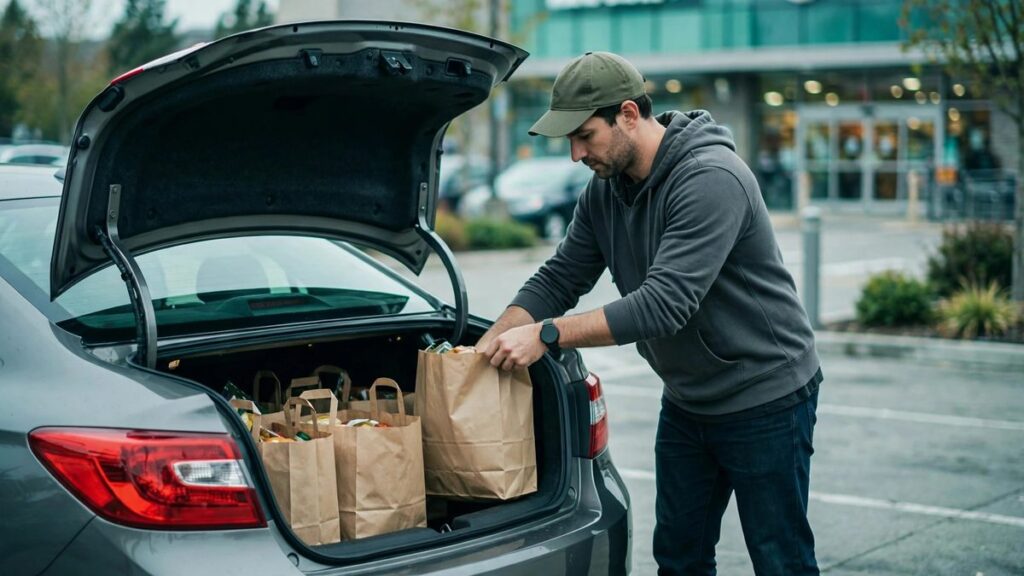
The official site lists three offer types: Delivery (pick up a packed order and drop it off), Shopping (you shop the items in-store, then deliver), and Returns offers. In practice, the work breaks down into three patterns: curbside pickups where you check in at a parking spot and a Walmart associate loads your car; batched general-merchandise orders with multiple delivery stops in one trip; and “Shop & Deliver” orders where you do the in-store shopping yourself.
Offers reach you two ways, per Spark’s official help documentation: Round Robin offers are sent directly to you (marked “Just for you” with a countdown timer), and First Come, First Serve offers are open to all nearby drivers in the zone. Third-party driver guides describe Round Robin offers as arriving roughly hourly and report that declining open offers doesn’t affect your acceptance rate — Spark’s official docs confirm the mechanisms but not those details. On offer priority, Spark’s official rewards terms say higher-tier drivers “may see some offers before drivers in lower tiers” — but add that tier “is one of several factors,” that priority matching “does not guarantee a particular number or type of offers,” and that the My Metrics ratings “are not performance requirements and do not affect your access to the Spark Driver app.” In short: reliability may help, but no metric guarantees better offers.
The short answer: how much Spark drivers make
Let’s start with the best measured data available, then work down to take-home pay.
Gross earnings (before any costs): Independent tracking firm Solo measured a verified panel of Spark drivers from January through June 2026 and found an average of $15 per delivery — $11 in base pay plus $4 in tips. Per hour, Spark drivers averaged $21.04 gross, ahead of Instacart ($16.03), DoorDash ($15.22), and Uber Eats ($14.32) in the same dataset. Separately, Gridwise’s 2025 Gig Mobility Report (via gigworkermoney.com) showed a median of $21.74/hour across 14,666 Spark drivers, rising to $22.57 with tips and bonuses — note the 2025 dataset, so treat it as a benchmark, not a 2026 measurement.
Actual take-home (after real costs): This is where honesty matters. Those figures are gross — before gas, maintenance, depreciation, insurance, and self-employment tax. ShiftTracker’s 2026 guide — a third-party estimate, not measured driver data — models roughly $18–$25/hour gross and $15–$22/hour net for typical drivers, with a net-after-gas (before taxes) table ranging from about $12/hour for random-hours drivers up to $32/hour for Saturday-only side hustlers. Treat these as modeled scenarios, not measured averages: your zone, hours, vehicle costs, and tax situation decide where you land, and beginners learning the ropes commonly land below the averages.
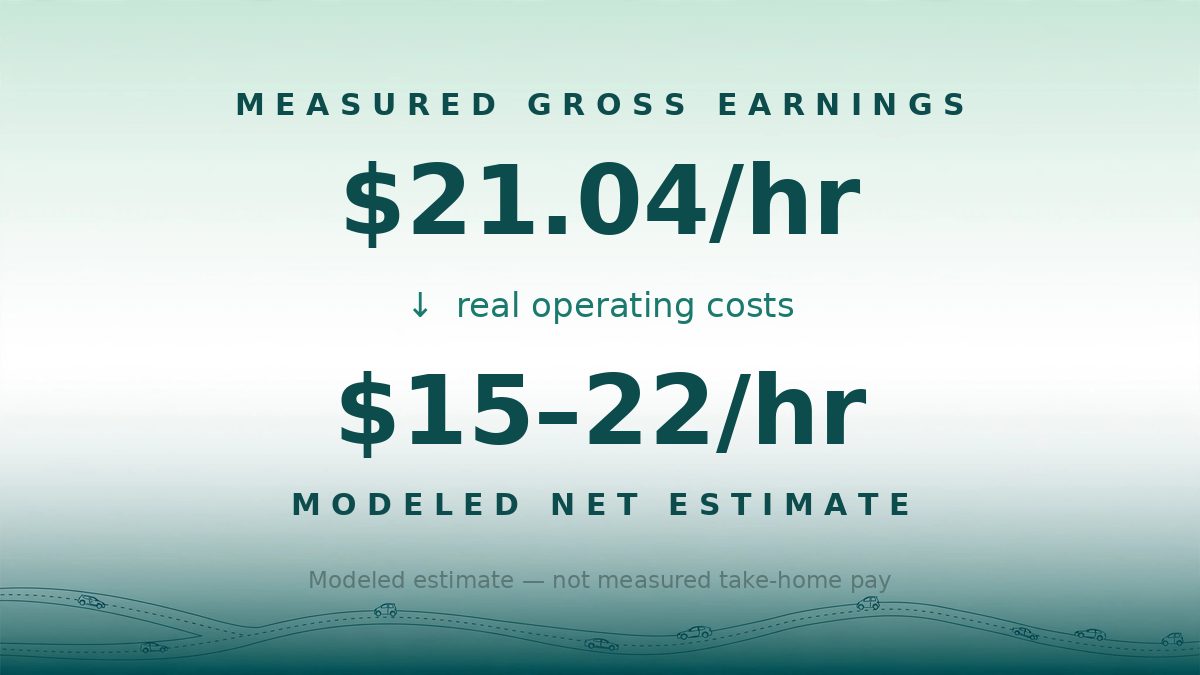
The gap between “$21.04 an hour” gross (measured data) and roughly “$15–$22 an hour” net (a modeled estimate, not measured data) is the entire story of gig driving. Every section below explains where that gap comes from.
What Walmart officially says about pay
Here’s something notable: as of October 2026, Walmart’s official Spark recruiting site makes no specific dollar-per-hour or per-delivery earnings claim. It describes ways to earn — incentives, promotions, a rewards program — but publishes no pay figures. That’s unusual compared to competitors like Amazon Flex, which advertises hourly ranges, and it’s worth knowing: there is no official number to hold Walmart to.
What the company does state: drivers keep 100% of customer tips, a longstanding policy. After the 2026 FTC settlement, a Walmart spokesperson restated it: “Drivers retain 100% of customer-confirmed tips in addition to the base pay for the trip.” Note the word “customer-confirmed” — it matters, and you’ll see why in the tip-baiting section.
Spark also runs an official rewards program: all drivers in good standing get Tier 1, while Tier 2 — requiring 20+ trips in the prior month plus a Green customer rating — unlocks perks like cellular discounts and a free month of Walmart+ membership. Some zones are piloting a revised Silver/Gold/Sapphire rewards structure.
The 2026 FTC settlement: what happened
You can’t honestly discuss Spark pay without the enforcement action. In February 2026, the FTC and 11 states filed a complaint alleging Walmart failed to pay Spark drivers promised base pay and tips, withheld incentive pay, and collected customer tips that were never paid to drivers. In March 2026, a court ordered a $100 million judgment: $79 million to affected drivers, $10 million distributed through the FTC, and $11 million in civil penalties. Walmart did not admit wrongdoing.
The order also imposed a 10-year Earnings Verification Program and banned Walmart from misrepresenting driver earnings or adjusting pay after an offer is accepted. Separately, Louisiana’s Attorney General reached a $1 million settlement with Walmart over the same allegations in July 2026.
What this means for you as a prospective driver: the settlement doesn’t mean Spark is a scam — it means the historical pay problems were serious enough to draw federal enforcement, and the resulting court order now legally constrains how Walmart can represent and adjust your pay. That’s genuinely protective for new drivers. But it also confirms that skepticism about advertised pay on this platform was warranted.
How the pay actually breaks down
Spark pay has three components: base pay + customer tips + incentives. Each has a catch.
Base pay is set per offer by Walmart’s dispatch algorithm based on distance, estimated effort (item count, shopping vs. delivery-only), and demand. Walmart publishes no floor. Third-party analyses in 2026 observed base pay of roughly $7–$14 per delivery, with some guides citing $12–$20+ per order in strong zones. Driver reports on the low end are blunt: “You live off the tips, the base pay is way below minimum wage.”
Tips average about $4 per delivery in measured Solo data (Jan–Jun 2026) — but 18.9% of deliveries have no tip at all, and tips make up 28% of total pay, so earnings swing with customer generosity. On adjustments, Spark’s current policy gives customers up to 3 hours to reduce a pre-tip (shortened from the old 24-hour window), up to 24 hours to add or increase a tip, and up to 14 days to add a post-tip when no tip was originally given. Until confirmed, tips show as “Unconfirmed tips.” Tip baiting — attracting drivers with a high shown tip, then reducing it — is extensively documented on Spark: one driver-advocacy site calls it “an epidemic,” quoting drivers saying “I’ve never seen an app with as much tip baiting as Spark,” and a 2026 Change.org petition (which confirms Walmart cut the reduction window from 24 hours to 3) asks Walmart to lock in displayed tips. Spark support does not compensate baited tips. The shorter reduction window helps, but the tip on the offer card is still not guaranteed money — budget as if unconfirmed tips aren’t there.
Incentives and Peak Pay add an estimated $2–$8 per order during high-demand windows — bad weather, holidays, understaffed zones — plus occasional trip-completion bonuses (complete N trips in a window). That range is a third-party estimate (ShiftTracker), not measured data. These bonuses are real but unpredictable; you can’t budget around them.
Batching dilutes pay. Measured Solo data (Jan–Jun 2026) shows single-stop offers average $20 per delivery, two-stop batches $13, and batches of three or more stops just $7. More stops, more driving, more stairs — for less per delivery. This is the single most useful pay fact in this guide: cherry-pick single-stop offers when you can. (Solo notes that whether batching still wins once you account for time saved isn’t something their data can answer yet.)
The real costs: gross vs. take-home
Here’s where $21.04/hour gross becomes roughly $15–$22/hour net (a modeled estimate, not measured data). Run your own numbers with these:
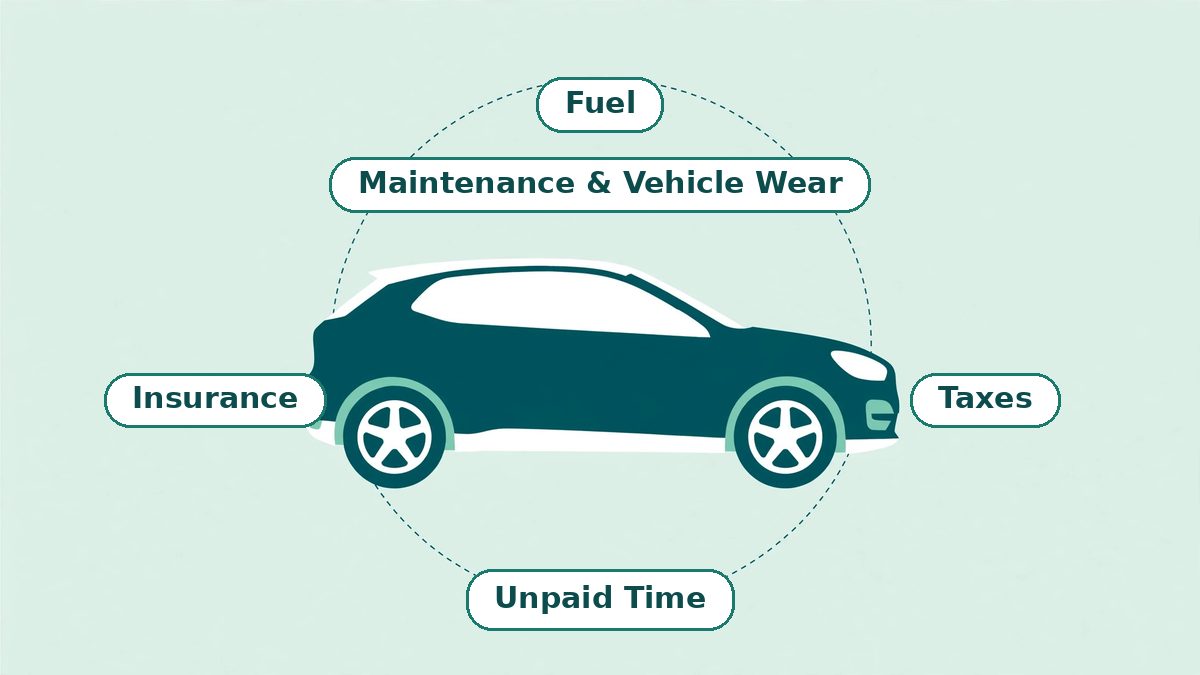
- Fuel. The biggest daily cost. Track it per shift, not per month — it makes the math undeniable.
- Maintenance and depreciation. Oil changes, tires, brakes, and the invisible cost of miles on your car’s value. The IRS standard mileage rate exists because driving genuinely costs roughly that much per mile; many experienced gig drivers use $1.50/mile including tips as a personal minimum for accepting an offer.
- Insurance — the trap most beginners miss. Personal auto policies typically exclude paid delivery driving — the standard ISO personal auto policy excludes coverage while a vehicle is “being used as a public or livery conveyance.” But “typically” matters: coverage depends on your specific policy, carrier, and state — not every personal policy automatically denies every delivery-related claim, and some carriers carve out limited exceptions. Call your insurer and ask directly before your first delivery. If you’re not covered, you’ll need a delivery/gig endorsement or a commercial policy, which costs extra. Price this before you sign up, not after your first accident.
- Self-employment tax. As a 1099 independent contractor, there’s no withholding — under IRS rules, the 15.3% self-employment tax applies to your net self-employment earnings (profit after business expenses), plus income tax, with quarterly estimated payments expected. As a budgeting rule of thumb — not a tax requirement — set aside around 20–25% of every payout in a separate account, or you’ll meet a painful April.
- Unpaid time. Waiting at curbside for an associate to load your car, driving to a busy zone, sitting between offers — none of it pays. Measured hourly figures divide earnings by active time; your real hourly rate includes the dead time.
- Phone and data. The app is your workplace; a dead phone is a dead shift.
Do this math for your first two weeks before deciding whether Spark is worth continuing. If the net hourly number doesn’t beat your alternatives, the gross number is just marketing.
What you need to start
The official requirements are straightforward: 18 or older, a valid driver’s license, proof of auto insurance, a background check (including motor-vehicle records — third-party guides report roughly 24–72 hours, though Spark publishes no official timing), a smartphone, and a vehicle in safe condition. Notably, Spark’s public eligibility page lists no vehicle specifications at all — consistent with no published model-year requirement, which is more lenient than rideshare apps. The signup process asks about handling physical grocery loads; drivers report a lift requirement of up to 60 lbs, though this isn’t stated in Spark’s public eligibility page.
Two practical notes: many zones have waitlists when driver supply is full, so approval isn’t instant everywhere; and Spark’s official FAQ describes payouts only as weekly (or instant) — it names no specific day, and the payout provider has varied by market and over time. Drivers commonly report Tuesday disbursements via a digital wallet, but treat the exact day and provider as subject to change.
Beginner strategy that actually helps
- Favor single-stop offers. The data is unambiguous: $20/delivery for one stop vs. $7 for three-plus. Batch orders look productive and pay worse per unit of effort.
- Learn your zone before grinding. The best offers cluster around specific stores at specific hours. Two weeks of deliberate observation beats two months of random driving.
- Work peak windows. Evenings, weekends, bad weather, holidays — that’s when incentives appear and tips improve. Random Tuesday afternoons are the worst-paying hours.
- Track every mile from day one. Use a mileage-tracking app. You’ll need it for taxes, and it forces you to see your true costs.
- Set the tax money aside immediately. Around 20–25% of each payout into a separate account, as a budgeting rule of thumb. Non-negotiable.
- Use the $1.50/mile rule. If an offer (including the shown tip) pays less than $1.50 per mile you’ll drive, decline it. Your car is not a charity.
- Don’t count unconfirmed tips. A pre-tip can be reduced for up to 3 hours after delivery (adding or increasing a tip has longer windows), so budget as if unconfirmed tips aren’t there.
Risks and downsides
Oversaturation is the #1 complaint. Multiple 2026 driver reviews describe the same pattern: strong earnings at first, then a flood of new drivers, then declining offers. One New York driver put it plainly: “They will start you off thinking you’re going to make good money! Then when you decline the little orders, you start getting less orders.” If your zone is waitlisted, that’s actually a signal the market may already be full.
Deactivation risk is real. Spark rates drivers on customer metrics (Green/Orange/Red tiers); customer complaints are taken seriously and background re-screening happens. Per Spark’s terms, new drivers who don’t complete their first delivery within 45 days can be automatically deactivated — that specific rule is narrower than a general inactivity policy, and longer-term inactivity terms are less clearly documented. Appeals run through Spark’s own process (drivers describe a pre-arbitration review), not anything resembling employee protections.
No safety net. No minimum wage, no overtime, no workers’ comp, no unemployment insurance, no benefits. An injury on a delivery is your problem and your insurer’s.
Physical toll. Grocery delivery means heavy carts, bulk items, stairs, and apartment complexes. The 60-lb lifting requirement is not theoretical.
Order fraud. Drivers report bots and account-sharing schemes that siphon the best orders, plus fake “Spark support” scam calls targeting drivers. In September 2026, a man was arrested in Georgia for allegedly using AI-generated fake Spark orders to steal electronics at pickup. Verify pickup codes carefully and never follow “support” instructions from an unsolicited call.
Who should NOT do Spark delivery
- You don’t have a reliable car, or your only vehicle is on its last legs — this job converts car value into cash, fast.
- Your insurance excludes delivery driving and you can’t afford an endorsement. An uninsured accident can cost more than a year of Spark earnings.
- Your zone is saturated or waitlisted. Check driver forums for your specific area before counting on this income.
- You can’t lift 60 lbs or have back, knee, or joint problems — grocery batches are physical.
- You need guaranteed, predictable income or benefits. Spark offers neither. If you need a steady paycheck, this is the wrong tool.
- You expect the offer card to be final. Between tip baiting, batching, and post-acceptance changes (now legally constrained, but the culture of variability remains), the number you tap “accept” on is an estimate.
FAQ
Is Spark driver a real job?
Yes — it’s real independent-contractor work moving real groceries for real pay, and drivers do cash out weekly. It’s not a scam. But “real” doesn’t mean “well-paid”: it’s piecework with no wage floor, and your earnings depend heavily on your zone, hours, and strategy.
How much can a beginner realistically make in the first month?
Expect the low end of the range while you learn. Measured data (Solo, Jan–Jun 2026) puts the overall average at $21.04/hour gross; after costs and taxes, beginners learning the ropes commonly land below the averages. Your first month is tuition — you’re learning which offers to take and which stores pay.
Do I need a new car?
No. Unlike Uber and Lyft, Spark has no vehicle model-year requirement — it just needs to be safe and insured. But an older car still burns gas and depreciates, so run the per-mile math honestly.
How long does approval take?
Spark publishes no official background-check timeframe — third-party guides report approximately 24–72 hours — and in zones with full driver supply, a waitlist can make the overall process longer even after you’re approved.
Can you do Spark full-time?
Some drivers do, usually by multi-apping across platforms and working peak hours strategically. But full-time means full-time vehicle costs, no benefits, and income that swings week to week. Most drivers use it as a side income, which is also how the math works best — your car already exists, so marginal costs are lower.
What happened with the FTC lawsuit?
In early 2026, the FTC and 11 states alleged Walmart failed to pay Spark drivers promised base pay and tips and withheld incentive pay. A March 2026 court order imposed a $100 million judgment ($79M to drivers) plus a 10-year earnings verification program, without Walmart admitting wrongdoing. A separate $1 million Louisiana settlement followed in July 2026. New drivers now operate under stronger legal protections than pre-2026 drivers had.
The bottom line
Spark drivers average $21.04/hour gross in measured data from the first half of 2026 — competitive with other delivery apps — but realistic take-home after gas, wear, insurance, taxes, and unpaid time is modeled around $15–$22/hour for typical drivers (ShiftTracker, 2026 estimate), with wide zone-to-zone swings and lower results for beginners. The 2026 FTC settlement is both a warning about the platform’s history and a genuine protection for new drivers going forward.
Spark is worth trying if you have a reliable car, proper insurance, an undersupplied zone, and realistic expectations — especially as a side income during peak hours. It’s a bad deal if you’re counting on the gross hourly figure, driving an unreliable car uninsured for delivery work, or in a saturated market. Run your own two-week numbers. The app won’t do that math for you.