The short answer: $500–$2,500 gets a lean solo operation off the ground, $5,000–$15,000 builds a properly equipped professional setup, and $20,000+ buys a commercial trailer rig.
The honest answer is messier than that. The $500 floor is real, but it’s tight — it means a consumer-grade washer, minimal accessories, and probably no insurance. And none of those tiers include a truck, which is the single biggest hidden cost if you don’t already own one. This guide breaks down what the money actually goes to, what you can realistically charge, how long break-even takes, and the risks the “start a pressure washing business this weekend” videos skip.
The short answer: three startup tiers
| Tier | Cost range | What it looks like |
|---|---|---|
| Lean / side-hustle start | $500–$2,500 | Consumer or entry-level gas washer, basic surface cleaner, chemicals, safety gear. You already own a vehicle. |
| Professional solo setup | $5,000–$15,000 | 4 GPM commercial gas washer, pro surface cleaner, full chemical kit, general liability insurance, LLC, basic marketing. |
| Commercial rig | $20,000–$50,000+ | Trailer-mounted washer, water tank, hot-water capability, commercial insurance, wrapped trailer. |
A few things these tiers assume: you already own a vehicle that can haul roughly 150 pounds of equipment. If you need to buy a truck or trailer, add $5,000–$15,000+ on top. And the bottom of the lean tier — $500 — works only with a consumer-grade machine and skips (or minimizes) insurance. Sources that price out a realistic and insurable lean start land closer to $1,000–$4,500. Keep that in mind as we go through the line items.
Equipment: what you actually need (and what it costs)
The pressure washer itself
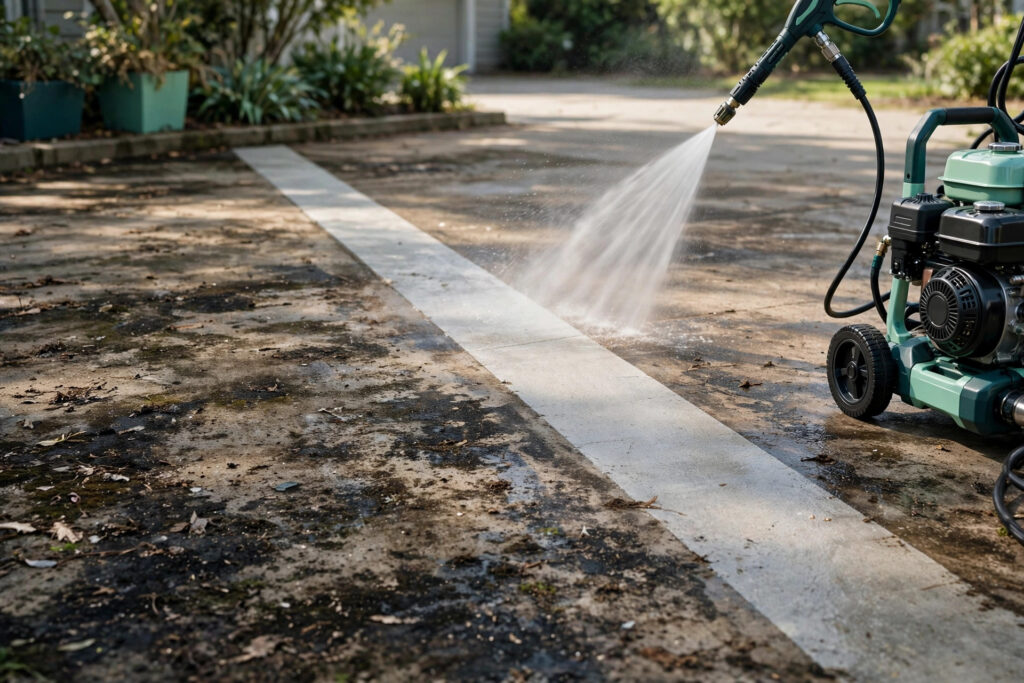
This is the big purchase. The consistent advice across operator guides: go gas, and prioritize GPM (gallons per minute) over PSI. A 4 GPM machine cleans roughly twice as fast as a 2 GPM machine, and speed determines how many jobs fit in a day — which is why a 4 GPM gas washer is the most commonly recommended starting point for residential work.
That’s a strong recommendation, not a law of physics. Electric units have legitimate niches (indoor work, noise-restricted neighborhoods, lighter jobs), and plenty of beginners start on a smaller gas machine and upgrade once the bookings justify it. The specific trap operators warn about is buying a consumer-grade electric washer as your business machine and replacing it within months once it’s running for hours at a time.
Real retail prices, checked October 2026:
| Machine | Specs | Price |
|---|---|---|
| Simpson MegaShot (consumer) | 3,100 PSI / 2.3 GPM | ~$350 |
| Simpson MegaShot (consumer) | 3,400 PSI / 2.5 GPM | ~$400 |
| Simpson PowerShot (pro) | 3,600 PSI / 2.5 GPM, Honda engine | ~$730 |
| Simpson PowerShot (pro) | 4,000 PSI / 3.5 GPM, Honda engine | ~$800–$840 |
| Simpson (pro-sumer) | 4,400 PSI / 4.0 GPM | ~$900 |
| Simpson commercial | 4,200 PSI / 4.0 GPM, Honda GX390 | ~$1,400 |
(Prices from Home Depot and Tractor Supply product listings.)
The practical takeaway: $350–$900 covers the realistic beginner range — a consumer gas unit at the bottom, a 4 GPM machine at the top. You do not need the $1,400 commercial unit to wash your first driveway.
The surface cleaner (don’t skip this)
A surface cleaner is the spinning disc attachment that cleans driveways and patios evenly. Without one, you’ll leave visible streaks and stripes on concrete — the classic beginner giveaway. Entry-level 15″ models run $40–$90 at retail; commercial-grade 14–16″ models run $150–$300+. This is one of the highest-value purchases on the list.
Accessories, chemicals, and safety gear
- Extension wand, nozzle/tip set, extra hose: ~$50–$150 to start. (Your washer ships with basic tips; you’ll want spares.)
- Downstream chemical injector: ~$15–$75. This lets the machine pull cleaning solution through the system — essential for house washing.
- Chemicals: sodium hypochlorite (pool shock) plus a surfactant and a degreaser. Budget $100–$300 for your initial stock. Restocking runs roughly $100–$200/month once you’re working regularly.
- Safety gear: goggles, waterproof gloves, non-slip boots, ear protection. $50–$150. Non-negotiable — high-pressure water causes serious injuries.
One critical distinction: soft washing vs. pressure washing
You do not blast a house with 4,000 PSI. House siding gets soft washed — low pressure (under 500 PSI, about garden-hose force) plus chemicals that do the cleaning. High pressure on vinyl siding cracks panels, strips coatings, forces water behind the siding (hello, mold and rot inside the wall), and can void siding warranties. Concrete and brick get high pressure (2,000–4,000 PSI). Wood decks need low pressure and care — too much pressure splinters softwoods.
Why does this matter for startup costs? Because a beginner who only knows “point and spray” is a liability claim waiting to happen. Which brings us to the least fun — and most important — line item.
Business setup costs: LLC, EIN, insurance, licenses
EIN: free
An Employer Identification Number is free directly from the IRS — it takes minutes online. (Beware third-party sites that charge you for it.) You’ll want one if you form an LLC or plan to hire anyone later; even as a sole proprietor, it keeps your Social Security number off paperwork.
LLC: $40–$500 to file, varies wildly by state
Filing fees differ by state: Florida is $125, Texas is $300, California is $70 to file but charges an $800/year minimum franchise tax — the most expensive state to maintain an LLC in. Budget options exist (Colorado, Kentucky, Michigan, Missouri are all around $40–$50). Check your own secretary of state’s site; don’t form out-of-state to “save money,” since you’ll usually have to register as a foreign LLC where you actually operate anyway.
You can also start as a sole proprietor for $0 and form the LLC later. Many solo operators do exactly that. The tradeoff is personal liability exposure — more on that below.
General liability insurance: ~$650–$1,800/year
This is the cost beginners most often skip, and the one they most regret skipping. For a solo pressure washing operator, general liability insurance typically runs $650–$1,800 per year for $1M/$2M coverage, based on 2026 insurance cost guides. If your vehicle is dedicated to the business, commercial auto coverage adds roughly $700–$2,150/year.
Two things to know before you buy:
- Standard general liability usually excludes damage to the surface you were hired to clean. Etch a customer’s driveway with the wrong nozzle and your GL policy may not cover the repair. Ask your insurer specifically about this exclusion.
- Insurance doesn’t replace technique. A $400 siding job done wrong can become a $4,000 repair bill — one operator guide’s warning, and an easy way to understand why the soft-wash distinction above matters more than any policy.
Licenses and permits: it depends on your city
There’s no federal pressure-washing license, and most states don’t require a trade-specific one. Most cities want a general business license (typically $50–$200). But local rules vary enormously, in both directions:
- Houston, Texas requires a dedicated pressure washer permit: recovery equipment (booms, mats, recovery systems) must be City-tested, and the company name and phone number must appear in 3-inch lettering on both sides of the vehicle (Houston Health Department, page reviewed November 2025).
- Florida goes the other direction: state law expressly lists pressure washing among the job scopes for which local governments may not require a license (Florida Statute §489.117). Note this bars contractor licensing specifically — it doesn’t address local business tax receipts, so check with your city on those.
Call your city’s business licensing office before your first job. It takes ten minutes and it’s the cheapest risk management you’ll ever do.
Ongoing monthly expenses
Once you’re running, the recurring costs are modest — which is genuinely one of this business’s advantages:
| Expense | Typical range |
|---|---|
| Chemical restock | $100–$200/month |
| Fuel (gas models) | $200–$500/month |
| Equipment maintenance (O-rings, fittings, nozzles, oil) | $100–$300/month |
| Insurance (amortized) | $55–$150/month |
| Basic marketing (door hangers, yard signs) | $50–$150 to start; more as you grow |
Water is the pleasant surprise: using the customer’s spigot is standard practice. You don’t need a water tank starting out — that’s an upgrade for remote jobs without water access. Vehicle wear is real but hard to quantify; just know it exists.
Can you start with no money? The honest version
Strictly “no money” — no. But “very little money” — yes, with caveats.
The lowest-cash path is renting the washer for your first few jobs. Daily rental rates at major outlets run roughly $50–$100/day for a gas unit (confirm at your local store — rates vary and aren’t published consistently online). The math only works if you line up the job before you rent: book a $200 driveway, rent the machine for $75, and you’ve netted the difference minus chemicals and fuel.
The catch, per operator consensus: rental eats margin fast. After a handful of jobs, buying a $350–$900 gas washer is cheaper than continuing to rent. Renting is a bridge, not a business model.
Borrowing a washer from someone you know works the same way — fine for job one, not a plan.
What can you actually charge?
Pricing varies by region — a lot. The Midwest and the coasts are different markets, and metro areas price higher than rural ones. Treat every number below as a range from 2026 sources, not a promise of what you’ll earn:
| Service | Typical price range (2026 sources) |
|---|---|
| Standard driveway | $100–$250 (Angi, 2026); ~$0.30–$0.55 per sq ft |
| One-story house wash (soft wash) | $150–$750 |
| Two-story house wash | $400–$1,400 |
| Deck or patio | $100–$350 |
| Fence | $150–$300 |
| Roof (soft wash) | $350–$700 |
To put the regional spread in concrete terms: one 2026 pricing analysis found a median of $0.31/sq ft in Des Moines vs. $0.47/sq ft in coastal Florida for driveway work. Your market is your market — check what local operators charge before you set prices, not what a national average says.
For more on pricing services so the work is actually worth your time, see our guide to pricing service side hustles and getting repeat clients. The fastest way beginners lose money here isn’t low prices — it’s underpricing out of nervousness, then discovering the job took twice as long as quoted.
How long until you break even?
Here’s where sources disagree, and you deserve to see the disagreement rather than a smoothed-over answer:
- Operator and educator Mike Vidan claims break-even “commonly happens within the first 3–10 jobs, with many operators profitable in their first month” (mikevidan.com).
- The team at VendBuddy published sobering funnel math: roughly 28 outreach attempts per completed job, ~100 attempts in month one yielding 3–4 jobs at ~$350 average — implying maybe $1,000–$1,400 gross in month one for a beginner starting from zero.
- Money Inc.’s business-calculator model puts typical break-even at ~15 months, likely assuming financed equipment, ad spend, and insurance overhead.
The honest synthesis: break-even speed depends almost entirely on how fast you book work, not on the equipment. A part-timer doing weekend driveways on a $1,500 setup can break even in a handful of jobs. Someone financing a $15,000 rig while paying for ads can take a season or more. Anyone who gives you a single number without asking about your booking rate is selling something.
A simplified illustration (assumptions stated, not a promise): $1,500 lean setup + $200 in first-month consumables = $1,700 out. At $200 per driveway with ~$25 in chemicals/fuel per job, each job contributes ~$175 toward recovery — about 10 jobs to cover startup. Whether those 10 jobs take three weeks or three months is the entire game.
Getting your first 5 customers
Forget ads on day one. The beginner playbook, per working operators:
- Claim and complete your Google Business Profile. Free, and it’s where “pressure washing near me” searches land. Fill in every field, add before-and-after photos, and ask every happy customer for a review.
- Door hangers on the 5 nearest houses after every job. Neighbors of a freshly cleaned driveway convert better than cold canvassing, operators report — you’re a known quantity on their street rather than a stranger. Reference the neighbor’s address on the hanger.
- Before-and-after photos in local Facebook groups and Nextdoor. This is among the highest-leverage free marketing in the business. One clean driveway photo outperforms a paragraph of ad copy.
- A yard sign on the client’s lawn (with permission) while you work, plus a few at busy intersections on weekends where local rules allow.
- Answer the phone. Operators consistently say slow response loses jobs. Speed of response beats polish of branding at this stage.
Our cleaning business startup guide covers the same local-service fundamentals — flyers, first-client scripts, and the “start before you’re ready” mindset transfer directly.
The risks and downsides (read before you buy anything)
Property damage is the big one. Etched concrete from holding the nozzle too close. Paint stripped off a deck. Cracked vinyl siding. Water forced behind siding that shows up as rot months later. Repair work is expensive, and as noted above, standard liability policies often exclude the very surface you were hired to clean. This is a business where technique errors have four-figure consequences.
Personal injury is real. High-pressure water can cause serious injuries. Never wash from a ladder — the wand’s kickback can throw you off. Never point the nozzle at yourself or anyone else. The safety gear section above isn’t optional.
It’s seasonal in much of the country. Northern states run roughly April through November; January and February are dead. Southern operators work year-round. If you’re starting in October in Minnesota, understand you may be waiting months for real revenue — or plan winter diversification (gutter cleaning, holiday lights, snow removal) from the start.
Drought restrictions can shut you down. This isn’t theoretical: as of September 2026, Hillsborough County, Florida extended drought restrictions through March 31, 2027, including a prohibition on non-commercial aesthetic pressure washing. Florida is simultaneously one of the biggest pressure-washing markets and one of the strictest on water use. Check your local water authority’s current rules.
Runoff rules apply — but they’re local, not universal. Federally, the Clean Water Act prohibits discharging pollutants into U.S. waters without a permit. In practice for this business, that means keeping wash water — and the oil, chemicals, and paint chips in it — out of storm drains, which flow untreated into waterways. What that requires of you depends on your city: common local expectations are blocking nearby storm drains, containing wash water, and discharging to a sanitary sewer with permission or reclaiming it. Some cities go much further — Houston requires a dedicated pressure washer permit with City-tested recovery equipment (see above). Others barely regulate residential work at all. The EPA also updated its lead-safe guidance for pressure washing in March 2026, which matters when working on older painted surfaces. For a residential driveway this is usually manageable; for commercial jobs, check your city’s stormwater rules before you bid.
It’s physical work. A 4 GPM washer weighs over 100 pounds. You’ll spend hours on your feet on wet concrete, in heat, handling chemicals. This is not a laptop business.
Theft happens. A $900 washer sitting in an open truck bed is exactly the kind of portable, high-value equipment thieves target. Lock it up, remove keys, record serial numbers.
Competition is established. You’re bidding against operators with hundreds of reviews and, in some markets, franchise outfits. Beginners win on responsiveness, reviews, and showing up — not by being the cheapest quote.
Who should NOT start a pressure washing business
- You want passive or low-effort income. This is manual labor in all weather. If that sentence tired you out, skip it.
- You don’t have a vehicle and can’t finance or borrow one. The equipment is heavy; “I’ll figure out transport later” is not a plan.
- You’re in an area with tightening water restrictions and no backup service to offer.
- You need winter income in a cold climate without a diversification plan.
- You’re uncomfortable with liability. If the idea of a $4,000 mistake keeps you up at night, the stress isn’t worth the margin — and that’s a perfectly fine conclusion.
None of that is meant to talk you out of it. Plenty of solo operators do well with this model. It’s meant to make sure you’re choosing it with open eyes, which is the entire point of HustleMint.
FAQ
Do I need a license to start a pressure washing business?
There’s no federal license and most states don’t require a trade-specific one, but most cities require a general business license ($50–$200 typically). A few places are stricter — Houston requires a dedicated pressure washer permit. Check with your city before your first job.
Can I use the customer’s water?
Yes — that’s standard practice. You don’t need a water tank starting out.
Gas or electric pressure washer for business?
Gas is the consistent recommendation across operator guides — a ~4 GPM gas machine is the most commonly suggested starting point for residential work. That said, it’s a recommendation, not a rule: electric units have legitimate niches (indoor work, noise-restricted neighborhoods, lighter jobs). The thing to avoid is buying a consumer-grade electric washer as your business machine and replacing it within months.
How much should I charge for a driveway?
2026 sources put a standard driveway at $100–$250, or roughly $0.30–$0.55 per square foot — but check your local market, because regional variation is large.
Can I pressure wash in winter?
In warm states, year-round. In cold states, the season runs roughly April–November. Plan for the gap.
Do I really need insurance?
It’s not legally required everywhere, but operating without it means one damaged driveway or one injury could cost you thousands out of pocket. At ~$650–$1,800/year for a solo operator, it’s the cheapest catastrophic-risk protection in the business. Just confirm with your insurer what the policy actually excludes.
The bottom line
A pressure washing business is one of the more honest side hustles out there: the startup costs are knowable, the ongoing expenses are modest, the skill is learnable, and customers pay for visible results. The realistic entry point is $1,000–$2,500 for an insurable lean setup (assuming you own a vehicle), not the $500 rock-bottom figure you’ll see in headlines — and the difference between profit and an expensive hobby is booking speed, technique, and respecting the liability.
If the local-service model appeals to you, our weekend side hustles roundup has more options in the same vein — and if you want the full playbook on pricing any service business, start here.