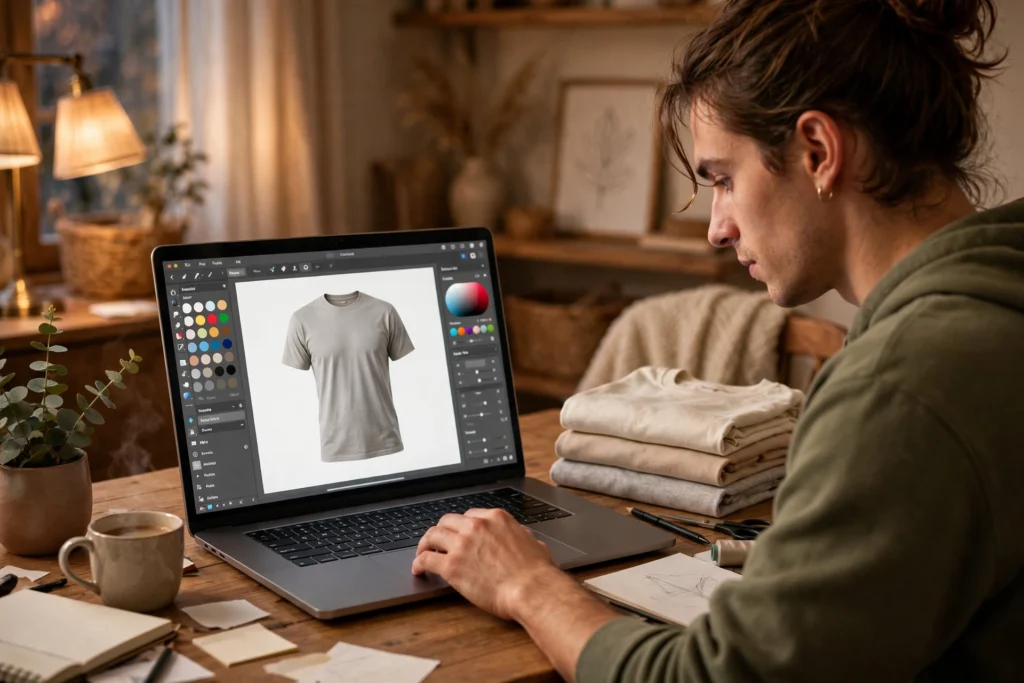
Print-on-demand sounds like free money: design a t-shirt, someone buys it, you pocket the difference — no inventory, no shipping, no warehouse. The first part is actually true. POD genuinely removes the inventory risk that kills most product businesses.
The honest part beginners miss: it replaces inventory risk with margin pressure and a marketing problem. Your per-item profit is thin, and a store with no traffic sells nothing. Nobody can quote you an expected income, and this guide won’t try to.
What it will do: show you how POD actually works in 2026, what it really costs to start small, how Printful and Printify differ after their merger, where free designs come from, the intellectual-property rules that get stores shut down, and how to market without a budget. Everything numbered is labeled by source type.
Disclosure: This post contains affiliate links. If you sign up through them, we may earn a commission at no extra cost to you.
How Print-on-Demand Actually Works
The model in one line: you create designs and list products; when a customer orders, the provider prints, packs, and ships white-label under your brand. Nothing is produced until someone pays.
Here’s the money flow, straight from Printful’s own pricing page: you set the retail price, the customer pays you, you pay the provider for the product plus fulfillment and shipping, and you keep the difference.
Three details that matter more than the pitch:
- Nobody holds inventory. The provider buys blanks in bulk; you never touch stock. That’s the entire economic difference between POD and traditional retail or wholesale.
- Orders can split. If your customer’s products come from different facilities, the provider may ship them separately — which raises your shipping cost on that order.
- Returns are the trap beginners miss. The split is simple but unforgiving: providers cover their errors (misprints, damage — Printful gives you 30 days from delivery to file a claim with photo evidence), but buyer’s remorse is your expense and your discretion. Custom-made items generally can’t be resold, so size exchanges and “changed my mind” returns come out of your pocket. And marketplaces add their own buyer-protection policies on top, which can cost you more than the provider reimburses. Budget for this.
This is also worth saying plainly: POD is not passive income. Designs, listings, SEO, customer service, marketing — it’s an active business. If you want the passive side of design, selling digital products is the closer cousin.
What It Really Costs to Start
There are three realistic launch paths, cheapest first. All numbers below are documented — nothing here is estimated.
Path A: $0 launch (marketplace + free POD tier)
Sell on a marketplace like Etsy with a free POD plan. Printful and Printify both offer free tiers with no monthly fee — you pay the base cost plus shipping only when a customer orders. On the marketplace side, Etsy charges a $0.20 listing fee per item (listings renew every four months whether they sell or not), plus a 6.5% transaction fee and US payment processing of 3% + $0.25 per order. New shops may also pay a one-time setup fee shown at signup. Once you pass $10,000 in trailing twelve-month sales, Etsy’s Offsite Ads (12–15% on attributed orders) become mandatory. Our Etsy seller guide covers the full setup — including the production-partner disclosure POD sellers must make — so this article won’t repeat it.
Path B: ~$15–30 launch (own storefront, free tools)
Skip the marketplace and run your own storefront. The cheapest credible version: a custom domain plus Printful Quick Stores — Printful’s own free storefront product (launched 2024), $0 with no billing method required, Stripe checkout, payouts to your bank monthly once profits exceed $25. The catch: it’s US-only (US-tax-resident merchants, US shipping addresses) and has no themes, marketing, or SEO tools. It’s a stepping stone, not a real store — but for $0, it’s the cheapest way to own your checkout.
A domain runs roughly $11 for the first year at a budget registrar — but budget the renewal, not the promo: renewals run closer to $18–$19/year, and the .com wholesale fee rises again in November 2026. Add $15–$30 for sample orders (below), and you’re live for under thirty dollars.
Path C: ~$40–50/month (Shopify)
Shopify Basic is $39/month ($29/month billed annually), plus 2.9% + 30¢ per online card transaction. It’s the standard serious-store platform — and it’s not the small-budget pick, because the subscription runs whether you sell or not. Start here only when sales justify it.
Sample orders: budget for them. Ordering your own products before listing is the cheapest quality control in this business — you check print quality, sizing, and packaging before a stranger does. Printful gives 20% off samples on the free plan (25% on the paid Growth plan), limited to one sample order per month of up to 3 items. Budget ~$15–$30 for one or two samples.
Printful vs Printify in 2026
This is the comparison every beginner asks about, and 2026 changed the framing: Printful and Printify merged in November 2024, and their combined parent reportedly rebranded as FYUL in November 2025 (per secondary reporting; Printful’s own LinkedIn confirms the merger). But — and this matters — as of September 2026 they still operate as fully separate platforms: separate sign-ups, dashboards, catalogs, pricing, and accounts. No forced migration.
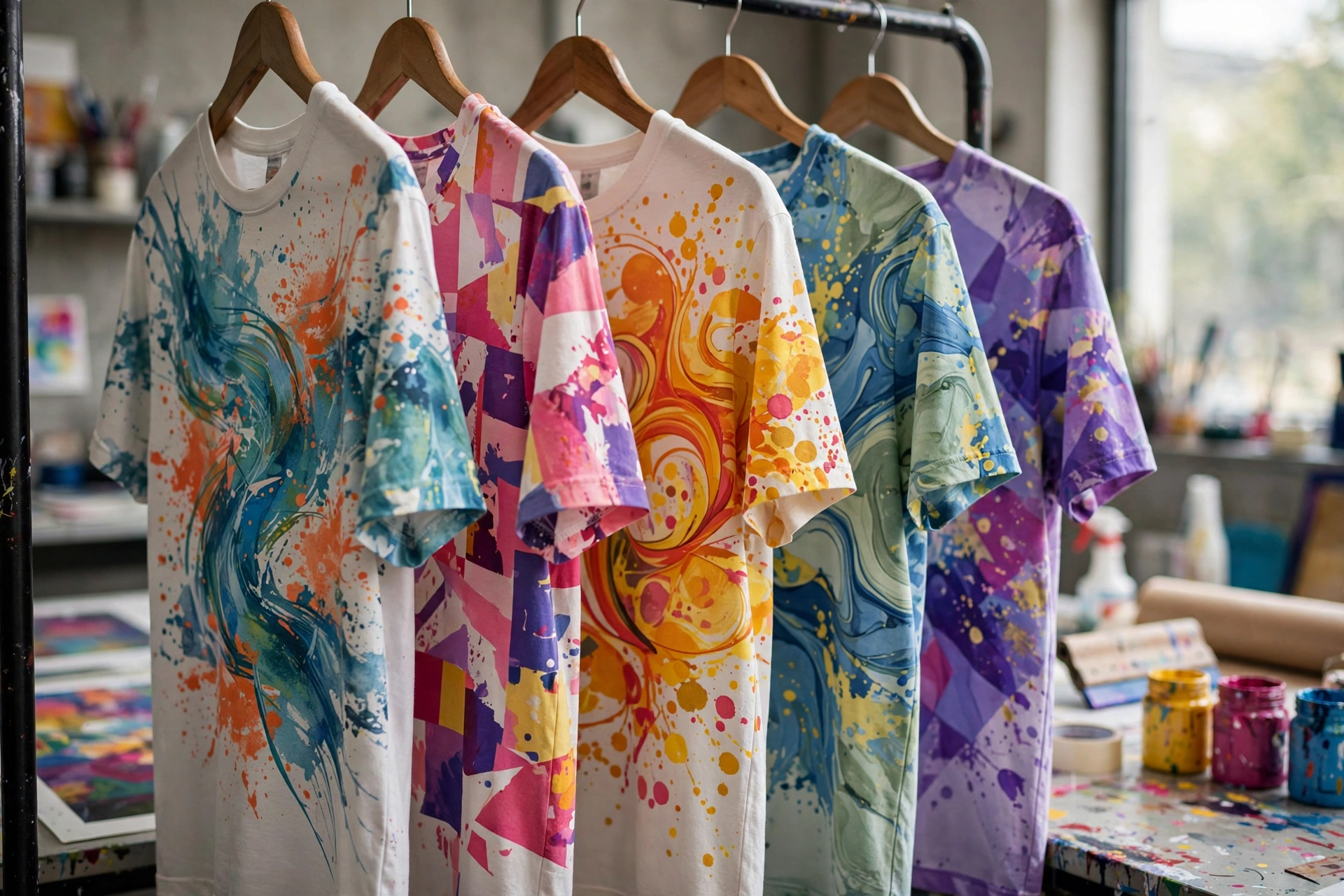
The architectural difference is unchanged and is the real decision point:
- Printful = in-house production. They own their fulfillment centers and run a 3-step quality check. More consistent quality, higher base costs.
- Printify = a marketplace of 90+ independent print providers. You choose the printer per product, and provider competition pushes base costs down. More variance in quality, lower prices.
Plans and pricing
| Printful | Printify | |
|---|---|---|
| Free tier | $0/mo — full catalog, unlimited stores, no monthly fees | $0/mo — 5 stores, unlimited designs, all integrations, 24/7 support |
| Paid tier | Growth: $24.99/mo, waived once you hit $12K/year in sales (14-day trial); up to 33% off products, 9% off branding, 25% off samples | Premium: $39/mo monthly, or $24.99/mo billed yearly; up to 20% off products, up to 33% off new products and custom branding |
| Top tier | Enterprise: custom pricing | Enterprise: custom pricing, unlimited stores |
Two 2026 changes to know: Printful consolidated its paid plans in January 2026 down to Free + one Growth tier. Printify raised its Premium monthly price from $29 to $39 in February 2026 (the annual plan held at $299/year) — at the monthly price, Premium rarely pays for itself for beginners.
Per-item base costs
Base costs change over time — always verify in the live catalog before you commit. Recent catalog figures for a classic t-shirt: Printful around $9.44 for a Gildan 5000 tee (per a September 2026 catalog readout), Printify from $7.95 — or about $5.92 with Premium — thanks to provider competition. A standard hoodie runs about $22.63 on Printful; an 11oz mug about $6.07. Note that Printful’s own older blog posts show lower figures (like $6.95 for the same tee) — those are stale, pre-price-increase numbers, not current pricing.
What’s included in the base price (per Printful’s official pricing page): the blank product, ONE print or embroidery placement, and fulfillment. Everything else is extra — additional print placements, embroidery digitization (one-time fee), premium stock images, custom labels, branded packaging and inserts. Prices also vary slightly by fulfillment location.
Shipping is the other half of your cost: Printful publishes US standard shipping per product category (flat-rate style — a t-shirt runs about $3.99 for the first item, $1.90 per additional item, per secondary reporting; a hoodie costs about $8.79 to ship domestically). Printify shipping varies by provider, typically $3.99–$5.49 for the first tee. Always confirm against the live shipping page — rates differ by product and destination.
Which should you pick?
- Pick Printful if you want consistent in-house quality, simpler operations, and don’t mind higher base costs eating margin.
- Pick Printify if you want the lowest base costs and are willing to vet individual print providers (order samples — provider quality varies).
- You can also use both: different products from different providers, or Printful for quality-sensitive items and Printify for price-sensitive ones.
The Margin Math (Illustrative)
Printful’s official profit formula: profit = retail price − (base cost + shipping + extras).
Worked example with the documented figures above: a Gildan 5000 tee at $9.44 base + $3.99 US shipping costs you ~$13.43 per order. At a $24.99 retail price, that’s ~$11.56 gross margin — roughly 45% — before marketplace fees and payment processing take their cut. On Etsy, the 6.5% transaction fee plus 3% + $0.25 processing would shave roughly another $2 off. This is arithmetic from labeled figures, not a promise — your numbers will differ by product, provider, shipping zone, and sales channel.
The margin lesson: discount tiers don’t equal margin. A 33% product discount on an item that ships across an ocean can lose to a pricier product printed twenty miles from the buyer. Your real cost is always blank + print + shipping to the buyer’s postcode.
And the earnings question, answered honestly: no public dataset exists for average POD seller earnings. Any “average POD store makes $X” figure you’ve seen is invented. The realistic expectation is a margin-per-item business where volume and marketing decide everything.
Designs Without Design Skills
You don’t need to be a designer, but you do need original, licensable artwork. Free starting points:
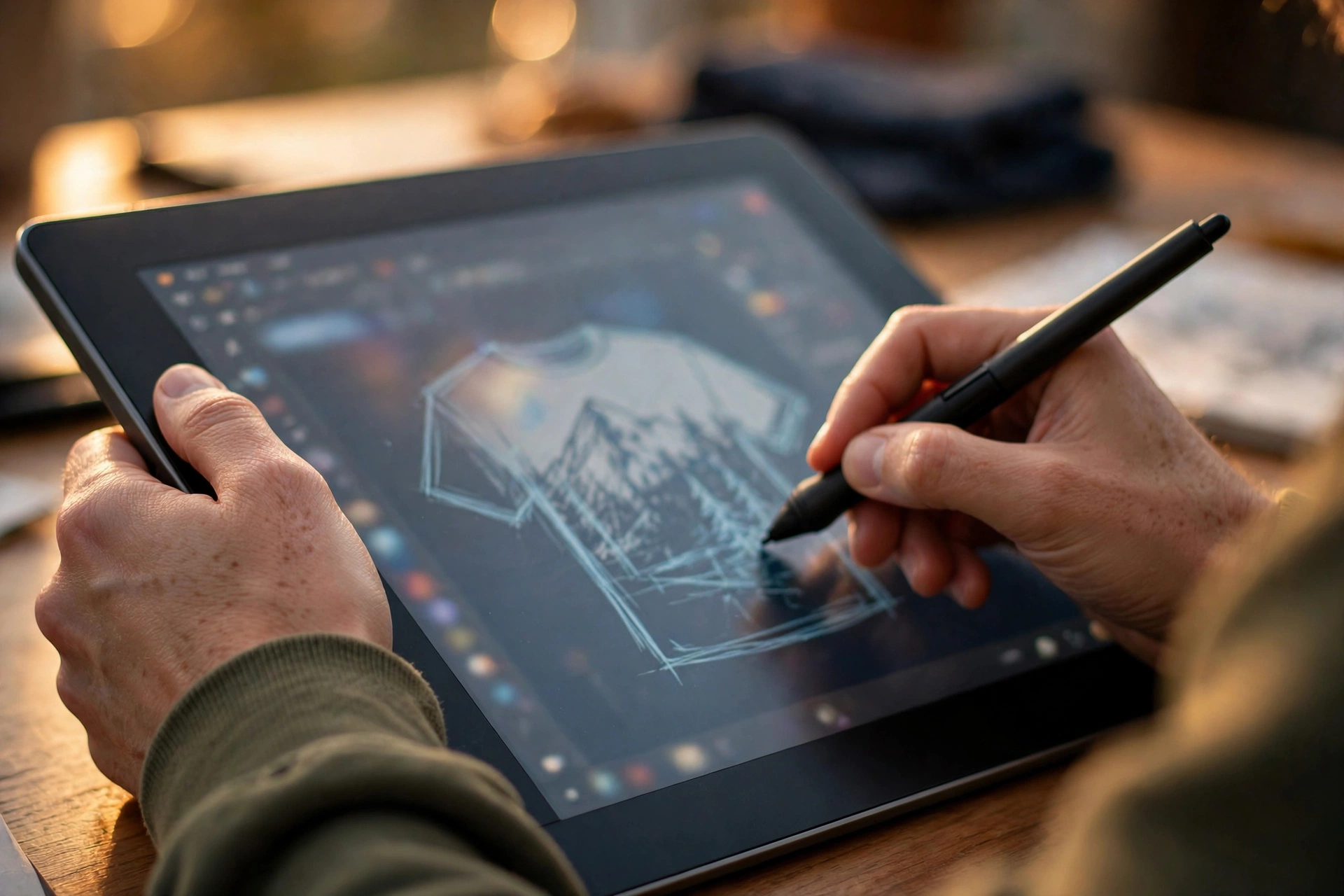
- Canva (free plan) — drag-and-drop templates; the free tier is enough to start.
- GIMP — free, open-source raster editor (Photoshop-class).
- Inkscape — free, open-source vector editor; good for print-ready logos and typography.
- Photopea — free in-browser editor that opens PSD files.
- Kittl — free plan, built specifically for merch and print typography.
- Printful Design Maker — free, with thousands of included graphics and fonts.
Export at 300 DPI in PNG, JPEG, or SVG — providers auto-generate mockups from your design file.
The IP rules that shut stores down
This is the section that saves businesses. Printful’s official content guidelines require you to own or have the rights to everything you submit — complying with trademark, copyright, and right-of-publicity law. Violating content can be removed at any time, and marketplaces routinely take down infringing listings.
The non-negotiables:
- No trademarked phrases, copyrighted characters, celebrity likenesses, or team/band logos. Drawing your own version of someone else’s IP can still violate their rights — the “change it 10% and it’s yours” rule is a myth, not a legal standard.
- Check before you print. The USPTO’s free trademark search is at tmsearch.uspto.gov (no account needed for basic search). If your design uses words, names, or logos, search them first.
- AI-generated designs have disclosure rules on marketplaces — Etsy’s tightened 2026 rules require AI-assisted designs to be genuinely seller-directed and disclosed. Generic templated designs get targeted.
- Names and likenesses need permission — including public figures. (Relevant if you’re tempted by 2026 midterms merch.)
IP takedowns are one of the top reasons POD stores die. Ten minutes of searching beats losing your shop.
Marketing on a Small Budget
The design is maybe 20% of the work. Distribution is the other 80%. A store with no traffic sells nothing, and paid ads are not a small-budget strategy. The free channels that work for POD in 2026:
- Etsy search SEO. Etsy is a search engine with tens of millions of active buyers. Titles, tags, and attributes decide whether your listing is ever seen — and at $0.20 a listing, testing designs is cheap. (Covered in our Etsy seller guide.)
- Short-form video. Product demos and niche-community videos on TikTok (and TikTok Shop, which both providers integrate with) are the main free-traffic engine for POD right now. Film the product, not the pitch.
- Pinterest. Visual search that acts as a free, long-lived traffic source for design-led products.
- Instagram organic. Niche accounts, reels of the design process, mockup carousels.
- Multi-channel listing. The same design on Etsy, TikTok Shop, and eBay spreads risk; integrations sync orders automatically.
One caution: Printify’s post-delivery issue tool (Printify Connect) doesn’t work on Etsy, eBay US, TikTok Shop US, or Amazon US — verify compatibility before relying on any provider’s tooling for a given channel.
2026 Changes Worth Knowing
- FYUL rebrand (Nov 2025): the Printful–Printify parent reportedly has a new name, but both platforms run independently. Expect gradual specialization, not a merger of the products.
- Printful simplified plans (Jan 2026): one paid Growth tier instead of several.
- Printify Premium price hike (Feb 2026): $29 → $39/month on monthly billing; annual billing held at $299/year.
- DTF printing is spreading across providers — direct-to-film removes a pre-treatment step from the older DTG process, with implications for print quality and durability. Worth knowing when you compare providers.
- Etsy tightened AI-design disclosure — genuinely seller-directed AI-assisted designs are allowed with disclosure; generic templated designs are targeted.
- Domain costs are creeping: the .com wholesale fee rises in November 2026. Budget renewals, not first-year promos.
Beginner Mistakes That Kill POD Stores
Consensus across seller guides (not a measured statistic, but the pattern is consistent):
- Generic designs in saturated niches. Funny-cat-shirt #4,000 competes with 3,999 others. Niches with real communities (hobbies, professions, fandoms you have rights to serve) beat generic humor.
- Underpricing below total cost. Forgetting shipping + marketplace fees + payment processing + the occasional return. Price from total cost, not base cost.
- No traffic source. The store is not the strategy; the audience is.
- IP takedowns. Covered above — the fastest way to lose listings and accounts.
- Treating it as passive income. It’s an active business: new designs, listings, SEO, customer service.
- Skipping samples. One bad print run reviewed publicly costs more than a $20 sample order.
- Betting everything on one platform or niche. Test designs cheaply, keep what sells, cut what doesn’t.
If you’re comparing POD to other no-inventory models, our reselling guide covers the main alternative.
Frequently Asked Questions
How much does it cost to start a print-on-demand business?
You can start at $0 with a marketplace shop (Etsy) and a free POD tier (Printful or Printify free plans) — you only pay base cost plus shipping when a customer orders. A realistic small budget is $15–$30 for a domain plus sample orders. Shopify at $39/month is not the small-budget pick.
Which is better, Printful or Printify?
They’re separate platforms under one parent company (reportedly rebranded FYUL) as of 2026. Printful offers consistent in-house production at higher base costs; Printify is a marketplace of 90+ print providers with lower base costs but variable quality. Beginners on a budget often start with either free tier and decide based on sample quality.
How much can you make with print-on-demand?
No public dataset exists for average POD seller earnings, so treat any “average” figure as invented. The honest math: a t-shirt sold at $24.99 with ~$13.43 in base cost plus shipping leaves roughly $11.56 gross margin before marketplace fees — about 45%. Volume and marketing decide everything else.
Do I need design skills for POD?
No, but you need original, licensable artwork. Free tools like Canva, GIMP, Inkscape, Photopea, and Kittl are enough to start, and Printful’s free Design Maker includes thousands of graphics and fonts.
Can I get in legal trouble selling POD designs?
Yes, if you use someone else’s intellectual property. No trademarked phrases, copyrighted characters, celebrity likenesses, or team logos — even redrawn versions can violate rights. Search the USPTO’s free database (tmsearch.uspto.gov) before printing, and disclose AI-assisted designs where marketplaces require it.
Is print-on-demand passive income?
No. It removes inventory risk, but the work — designs, listings, SEO, customer service, marketing — is active and ongoing. Treat it as a small business, not a passive investment.
The Bottom Line
Print-on-demand is one of the cheapest real businesses you can start: $0 gets you in the door, $30 gets you a domain and sample orders, and nobody can stick you with unsold inventory. That’s genuinely rare.
But the price of that cheap entry is paid elsewhere — in thin per-item margins, in the marketing work that decides whether anyone ever sees your products, and in the IP discipline that keeps your shop alive. The sellers who make it work share a boring playbook: original designs for real niches, prices built from total cost, samples before listings, and an actual traffic source.
Start small, test cheaply, and let sales — not optimism — decide when to spend more.
Sources
- Printful — pricing (official; profit formula, plan details, sample discounts)
- Printful — shipping speeds and pricing (official)
- Printful — return policy (official; 30-day claims, no buyer’s-remorse refunds)
- Printful — acceptable content guidelines (official; IP requirements)
- Printful — Quick Stores (official; free, US-only, $25 payout threshold)
- Printify — pricing (official; Free and Premium tiers)
- USPTO trademark search (official)
- BuiltByFoundry — 2026 catalog cost readout (secondary; Sept 2026 Printful base costs)
- Ink & Pxl — Printify vs Printful profit guide, April 2026 (secondary; per-unit cost comparison)
- SideHustle.site — Printful vs Printify merger explainer (secondary; FYUL rebrand)
- TrakSource — Printify review (secondary; Premium price change detail)
- PageFly — Etsy fees citing Etsy’s official Fees & Payments Policy (secondary)